Custard-Filled Éclairs Recipe with Homemade Choux
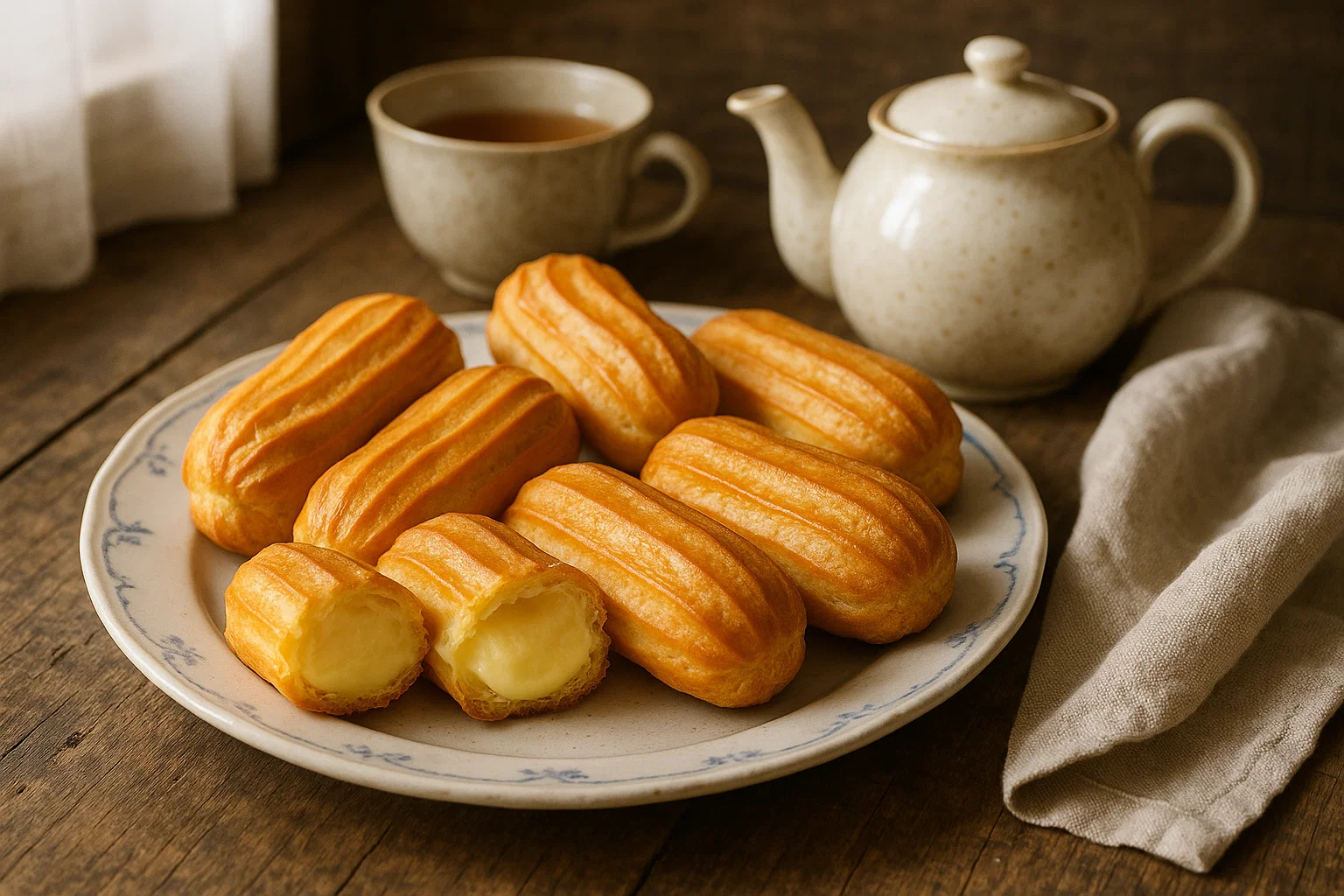
These custard-filled éclairs have light, hollow choux shells and a thick vanilla filling made with milk, egg yolks and flour. The water-based pastry is piped into fingers, baked until well coloured and dry, then filled only after the shells and custard have cooled. The batch makes about 12 éclairs, with optional butter for a richer cream. Allow roughly 3½ hours including chilling, and serve the pastries soon after filling for the best contrast between crisp shell and smooth centre.
Custard-filled éclairs are easier to organise when you treat the shells and filling as two separate jobs. Make the vanilla custard first so it can chill while you cook, pipe and bake the choux. The pastry rises from steam, creating a cavity that holds the cream once the shell is dry enough to stay upright. This version keeps the existing all-water choux and flour-thickened egg-yolk filling, rather than replacing them with a milk-based dough or cornstarch cream. It yields about 12 finger-shaped pastries. Most problems come from dough that is too loose, shells that leave the oven too early or filling that is still warm. The texture cues below matter more than forcing every last drop of egg into the dough.
Plan the baking and chilling
Allow about 45 minutes of hands-on preparation, 50 minutes of cooking and baking, and roughly 2 hours for cooling and chilling. Some work overlaps, but the cream must be cold before assembly. A shallow container chills faster than a deep bowl; check the centre rather than assuming a set time guarantees it is ready.
Prepare two lined baking sheets, a saucepan for the choux, a second pan for the custard, mixing bowls, whisk, sturdy spoon, cooling rack and piping bags. A 12–15 mm plain or star nozzle is useful for the shells. A small filling nozzle or a serrated knife gives two different ways to assemble them. A kitchen scale and oven thermometer improve consistency.
Keep the two flour quantities separate
The choux uses 250 ml water, 100 g butter and 150 g all-purpose flour, with a pinch of salt and up to four medium eggs. Measure the water: 250 ml is about 1 US cup plus 2 teaspoons. Weigh the flour and butter rather than packing them into cups. Use plain all-purpose flour, not self-raising flour; the lift comes from steam.
The custard uses another 40 g flour with 500 ml milk, four yolks, 150 g sugar and 10 g vanilla sugar. Whole milk gives a fuller texture. The 150 g sugar is about ¾ US cup, and 500 ml milk about 2 US cups plus 2 teaspoons. The optional 100 g butter makes a noticeably richer filling; it does not replace any milk or flour.
The four whole eggs belong to the pastry and the four yolks to the custard. Keep them in separately labelled bowls. Egg sizes differ between countries, so beat the last pastry egg and add it in small amounts only until the dough reaches the described consistency. Holding some back is preferable to a runny mixture that spreads across the tray.
Recipe card
Custard-Filled Éclairs Recipe with Homemade Choux
About 45 min preparation, 50 min cooking/baking and 2 hours cooling/chilling. Some work can overlap; custard must be cold before filling. Extra baking time may be needed.
Equipment: Kitchen scale, 2 saucepans, bowls, whisk, sturdy spoon or mixer, 2 lined baking sheets, piping bags and 12–15 mm nozzle, cooling rack, shallow custard container; oven thermometer useful
Ingredients
Water-based choux pastry
Vanilla custard
Instructions
Cook the vanilla custard first
Warm 500 ml milk until steaming. In a heatproof bowl whisk 4 yolks, 150 g sugar and 40 g flour until smooth. Slowly whisk in the hot milk, then return everything to the pan. Cook over medium-low heat, whisking across the base and corners, until thick and gently bubbling. Continue whisking for about 1 minute. Remove from the heat and stir in 10 g vanilla sugar and optional 100 g butter until smooth.
Cool the cream promptly
Spread the custard into a shallow clean container, cover its surface and cool quickly, using an ice-water bath if helpful. Refrigerate promptly at 4°C/40°F or below until cold throughout, allowing roughly 2 hours depending on depth. Do not leave it on the counter while finishing the pastries.
Cook the choux paste
Heat a conventional oven to 200°C/390°F and line two baking sheets. Put 250 ml water, 100 g butter and a pinch of salt in a saucepan. When the butter has melted and the liquid reaches a full boil, remove from the heat and add 150 g flour all at once. Beat vigorously, then return to medium-low heat and stir for 1–2 minutes until cohesive and pulling from the sides.
Cool the paste and beat in eggs
Transfer the paste to a bowl and stir occasionally for 5–10 minutes until warm rather than hot, below about 52°C/125°F if measured. Beat in 3 medium eggs one at a time until each is incorporated. Beat the fourth separately and add gradually until the dough is glossy, pipeable and falls slowly from a spatula in a thick V; you may not need every drop.
Pipe twelve fingers
Fit a piping bag with a 12–15 mm nozzle. Pipe about twelve even 10 cm/4 inch fingers, leaving at least 5 cm/2 inches between them. Smooth sharp tips with a damp fingertip. Keep uncooked dough covered if baking one tray at a time.
Bake until firm and dry
Bake for 20 minutes at 200°C/390°F without opening the door, then reduce to 180°C/355°F and bake about 15–20 minutes more. The shells should be deep golden and firm on the sides. Once set, make a small vent in each, then return to the oven for 5 minutes if needed to dry. Switch off, leave the door slightly ajar for about 10 minutes, then cool completely on a rack.
Fill only when both parts are cool
Stir the chilled custard briefly until smooth. Make small filling holes underneath each shell and pipe gently until it feels filled, or split lengthways and spoon in the cream. Fill close to serving time and refrigerate immediately if not serving at once.
Understanding the choux texture
The cooked flour paste should come together around the spoon and leave a light film on a stainless-steel pan. Do not boil the water and butter for several minutes before adding flour: evaporation changes the ratio. Bring them just to a full boil once the butter has melted, then add the flour promptly.
After cooking the paste briefly, spread it in a bowl and stir to release steam. It should be warm rather than hot before you add eggs. The mixture can look slippery or separated after each addition; keep beating until it becomes cohesive before adding more. At the end, it should be glossy and fall slowly from a lifted spatula in a thick V, while a piped ridge still holds.
The King Arthur Baking choux guide is a useful reference for cooking the paste and incorporating eggs. The quantities here remain those of this FeastDelights recipe. If you want the site’s milk-and-water dough with a different cream, see the separate choux éclair recipe; its ingredient proportions are different.
Pipe and bake for a dry shell
Pipe approximately twelve 10 cm/4 inch fingers with steady pressure. Keep them similar in width and allow at least 5 cm/2 inches between them. Dip a fingertip in water to flatten sharp ends, which can burn before the main shell is baked. If twelve fingers are too crowded on one tray, use two rather than squeezing them together.
Begin in a fully heated conventional oven at 200°C/390°F, then lower to 180°C/355°F as directed in the card. Keep the door closed during the rise. After the initial bake, the shells should be deep golden, firm and light, including their sides. A pale, soft side means more drying is needed even if the top is brown.
Once set, make a small vent in each shell to let steam escape and return briefly to the oven. Venting an underbaked shell too early can collapse it, so wait until it holds its shape. Cool on a rack. If a test shell has a thick wet membrane inside, extend the drying time for the remaining shells.
A custard thick enough to stay inside
Whisk the yolks, sugar and flour until smooth, then add hot milk gradually while whisking. This warms the eggs without cooking them into lumps. Once returned to the pan, scrape the corners and base continuously; the custard thickens first where it is hottest.
This is a flour-thickened pastry cream, so it needs to reach a gentle bubbling stage while being stirred. It is not a thin pouring custard that should be taken off the heat as soon as it coats a spoon. After it begins to bubble, cook gently for about 1 minute while whisking, then remove from the heat and add vanilla sugar and optional butter.
If there are small lumps, pass the hot cream through a fine sieve. Transfer to a shallow clean container, cover the surface with suitable food-safe wrap or a close-fitting cover, cool quickly using an ice-water bath if necessary, and refrigerate promptly. Do not leave a deep pan of custard on the counter until the evening.
Troubleshooting the finished pastries
Flat shells: the dough may have had too much egg, or the oven may not have been fully heated. Do not try to correct loose egg-enriched choux by stirring in raw flour; it will not behave like the cooked paste. Bake a small test finger if the consistency is uncertain.
Shells rise, then collapse: the walls were probably not dry and firm enough, or the oven was opened before the structure set. Extend the lower-temperature bake and judge the sides and base as well as the top.
Custard leaks: either it is still warm, it was undercooked, or the shell has a large opening. Chill fully, stir briefly until smooth and pipe slowly. Splitting the shell lengthways is a practical option when filling through small holes is difficult.
Soft pastry after filling: moisture transfers from cream to shell. Fill shortly before serving; a refrigerated filled éclair will naturally soften. Do not put filled pastries back into a hot oven to restore crispness.
Variations, serving and allergens
The existing chocolate variation adds 50 g finely chopped dark chocolate to the hot custard after cooking. Stir until melted, then chill as for vanilla cream. Chocolate changes sweetness and firmness; check its label for milk, soy and other allergens. A dusting of icing sugar or a thin drizzle of melted chocolate is optional and is not included in the base ingredient quantities.
Serve with coffee, tea or fresh berries on the side. Keep wet fruit separate from the shells until the last moment. For a round choux dessert, see profiteroles with vanilla cream and chocolate. For a sliceable dessert using a different pastry base, try vanilla custard tart.
The base recipe contains wheat, egg and milk. Butter and milk substitutions do not remove the eggs or make the recipe suitable for every dietary need. A gluten-free choux requires a separate formula rather than an untested spoon-for-spoon flour swap. Nutrition values are omitted because pastry size, unused egg and optional butter affect the calculation.
Make ahead and storage
Keep the cold custard covered at 4°C/40°F or below and use within 2 days. Store fully cooled unfilled shells in a dry container for up to 1 day, or freeze them for up to 1 month for quality. Re-crisp unfilled shells only in a 160°C/325°F oven for a few minutes, then cool completely before filling.
Refrigerate filled éclairs immediately and use within 2 days of making the custard, rather than starting a new two-day count at assembly. They are best on the day filled. Do not leave the cream or filled pastries unrefrigerated for more than 2 hours, or 1 hour above 32°C/90°F. These chilled pastries do not need reheating. Freezing the filled pastries is not recommended because this flour-thickened cream may separate and the shells soften.
Dry, well-baked shells and fully chilled custard make the difference. Keep the components separate until serving time, then fill gently so each éclair holds a smooth centre without losing its shape.
Frequently asked questions
Do I have to use all four eggs in the choux?
No. Keep four medium eggs available, but add the final beaten egg gradually and stop at the correct consistency. Flour absorption and moisture lost during cooking affect how much is needed.
Can I use large eggs instead of medium eggs?
Large eggs contain more liquid. Beat them and add gradually, judging the dough rather than using four automatically. Record the amount used if repeating the batch.
Why is there no baking powder?
Steam expands the dough in the oven, and the egg-and-flour structure sets around the hollow centre. Baking powder is not needed for this choux formula.
Can I pipe the shells without a special nozzle?
A sturdy piping bag with an evenly cut opening can work. Keep the width consistent and avoid a thin disposable bag that may split under pressure.
Can I use vanilla extract instead of vanilla sugar?
Replace the 10 g vanilla sugar with 10 g plain sugar and about 1 teaspoon vanilla extract. Add the extract off the heat. This keeps the sugar amount close to the original.
Can I omit the custard butter?
Yes, it is optional in this recipe. The flour and egg yolks provide the thickening. The cream will taste lighter and be less rich without the extra butter.
Why is there a skin on my custard?
The exposed surface dried as it cooled. Cover the surface promptly with suitable food-safe wrap or a close cover. If a skin has already formed, remove it before stirring and filling.
Can I freeze the unfilled shells?
Yes. Freeze fully cooled shells in a sealed container for up to 1 month for quality. Refresh them briefly in the oven, then cool completely before adding refrigerated custard.
Can I fill them the night before?
You can if they remain refrigerated, but the shells soften as they absorb moisture. For the clearest crisp-and-creamy contrast, keep shells and custard separate and assemble near serving.
More recipes to try

Cream Cheese Chocolate Truffles Rolled in Cocoa

Cream Cheese Cheesecake Danish with Lemon and Vanilla

Fresh Fruit Salad with Orange Honey Dressing

Ptichye Moloko Bird’s Milk Mousse with Chocolate Glaze
Bird’s Milk Jello with Creamy Mousse and Raspberry Jelly
Cream Horn Trubochki with Vanilla Cream Filling
Spotted a detail that needs correcting? Contact the FeastDelights editors.