Large-Batch Zucchini Caviar with Fresh Tomatoes
This large-batch zucchini caviar is a savoury cooked vegetable spread made with fresh tomatoes, zucchini, carrot, onion and garlic. The vegetables simmer uncovered until they collapse and excess water evaporates, then blend into a smooth or lightly textured relish. A little vinegar balances the sweetness of the cooked vegetables, but it does not make the recipe safe for pantry canning. Allow about 85 minutes for preparation and cooking. The batch targets two litres; portion it into shallow containers to refrigerate or freeze and serve with bread or potatoes.
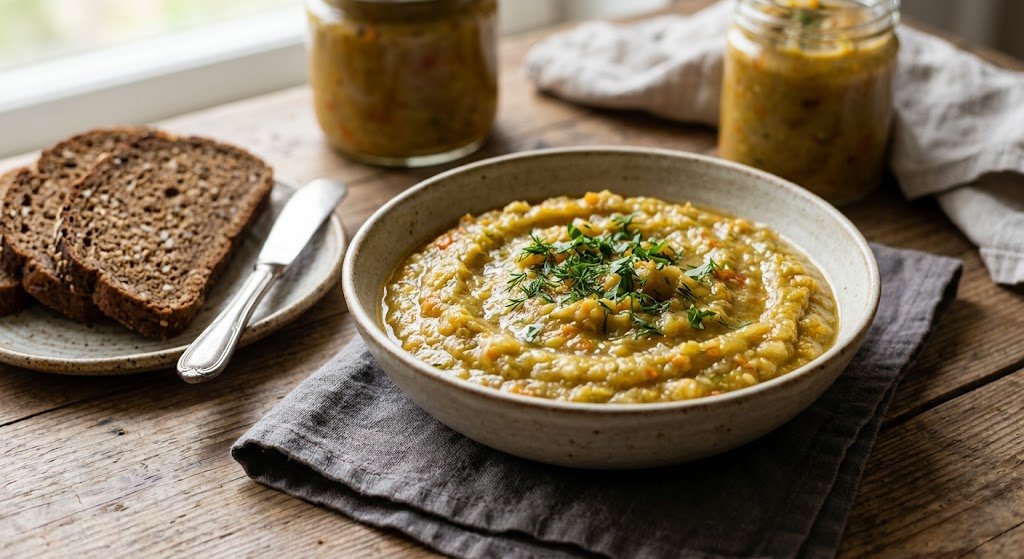
Large-batch zucchini caviar with fresh tomatoes is a thick, tangy vegetable spread made with zucchini, ripe tomatoes, carrot, onion and garlic. It takes approximately 85 minutes and targets two litres, depending on how much water evaporates. The spread is intended for refrigeration or freezing, not shelf-stable winter canning.
Recipe card
Large-Batch Zucchini Caviar with Fresh Tomatoes
The original two-litre yield is approximate. Juicy tomatoes or larger zucchini may require longer reduction; use the spoon test rather than the clock alone.
Equipment: Scale, knife, cutting board, grater, large wide heavy-based pot (at least 5–6 litres), long spatula, immersion blender, shallow refrigerator-safe containers
Ingredients
Vegetables
Cooking and seasoning
Instructions
Soften onion and carrot
Wash the vegetables. Dice zucchini and tomatoes, dice onion and grate carrot. Heat sunflower oil in a wide heavy pot over medium-low heat. Cook onion and carrot for about 8 minutes, stirring, until softened without dark browning.
Reduce zucchini and tomatoes
Add zucchini and fresh tomatoes. Cook uncovered over medium to medium-low heat for 35–45 minutes, stirring and scraping the base. Work in a sufficiently large pot so vegetables have room to release steam. Cook until soft and excess liquid has reduced; continue gently if the mixture remains watery.
Season the vegetable mixture
Stir in minced garlic, sugar, salt, pepper and the listed 9% vinegar. Simmer for 5 minutes, stirring. Adjust the balance after tasting a cooled spoonful. Vinegar is included for flavour, not as a canning safety measure.
Blend and finish cooking
Take the pot off the heat. Use an immersion blender with the blade submerged to reduce splashes; blend to the desired texture. Return to low heat and stir for about 3 minutes. The spread should be thick enough to hold a soft mound on a spoon without a pool of watery liquid.
Cool and refrigerate or freeze
Divide promptly into shallow clean containers for rapid cooling. Refrigerate within 2 hours (1 hour above 32°C/90°F) at 4°C/40°F or below, or freeze in suitable containers. Do not fill hot jars and store them in a pantry; this recipe has no tested canning process.
Choose vegetables for a thick spread
Use firm zucchini and ripe tomatoes. Small zucchini can usually be diced with their tender skins, while large mature ones may have tough skins and large seeds; remove these if needed. Tomatoes provide acidity and colour, and carrots and onions contribute natural sweetness. Weigh the prepared vegetables to keep the proportions close to the original formula.
A wide, heavy pot is useful because this is a large batch. A narrow saucepan traps steam, prolonging cooking and making it harder to reduce the vegetable liquid. Sunflower oil softens the onion and carrot before the zucchini and tomatoes are added. Olive oil is a possible flavour variation.
Reduce the vegetables before blending
Cook onion and carrot until tender rather than deeply browned. Add the zucchini and tomatoes and simmer uncovered, stirring and scraping the base. The vegetables will release liquid before they collapse. Resist adding extra water unless the mixture is catching; the aim is to evaporate moisture to form a spread.
Once the vegetables are soft and the mixture has reduced, add garlic, sugar, salt, pepper and vinegar. Cook briefly so the seasoning is distributed. Taste a cooled sample. Nine-percent vinegar is stronger than many standard supermarket vinegars. For flavour, the acid-equivalent amount of 5% vinegar is approximately 3.6 tablespoons in place of 2 tablespoons of 9%, though the taste and liquid volume may differ. This is not a preservation adjustment.
Blend off the heat using an immersion blender and keep the blade submerged. Hot vegetable purée can splash. Blend until smooth or leave a little texture, then return to low heat briefly. Draw a spoon through the mixture: the spread should hold a soft mound without a watery ring. It may thicken slightly during cooling. If still loose, reduce gently and stir frequently.
Troubleshooting and variations
Watery texture: extend the uncovered simmer rather than adding flour. Scorching: lower heat and stir along the base, particularly after blending. Too sharp: balance the flavour gradually with the listed sugar rather than adding extra acid for preservation. Too thick: loosen with a small amount of water during cooking. Actual yield varies with vegetable moisture; measure the finished batch rather than relying on exactly two litres.
Serving ideas and related recipes
Serve cold or at room temperature in small portions with rye bread, boiled potatoes or roasted vegetables. Try our rye and wheat bread as a base. This large fresh-tomato batch differs from the smaller smooth zucchini caviar with tomato paste and refrigerator zucchini caviar with lemon. None of those links should be interpreted as proof that a homemade spread can be stored in a pantry.
Important: refrigeration and freezing only
The historical URL refers to winter storage, but this formulation has no research-tested canning process or measured final acidity. Low-acid vegetables such as zucchini must not be treated as shelf-stable just because vinegar was added or a jar formed a vacuum. Follow the National Center for Home Food Preservation’s tested-process guidance for actual canning recipes.
Divide the cooked spread into shallow containers and refrigerate within two hours, or one hour above 32°C (90°F). Use within three days at 4°C (40°F) or below. For longer storage, freeze portions for up to three months for best quality, leaving space for expansion. Thaw in the refrigerator and stir before serving. See FoodSafety.gov’s cooling and storage guidance. Check oil, vinegar and packaged seasoning labels for cross-contact.
Frequently asked questions
What is zucchini caviar?
It is a cooked vegetable spread sometimes called squash ikra. This recipe combines zucchini with fresh tomato, carrot, onion and garlic; it contains no fish roe.
Can I can zucchini caviar for winter?
Not with this formula. It has no validated canning process or measured acidity. Refrigerate or freeze even if a jar seals.
Can I use 5% vinegar instead of 9%?
For taste only, 2 tablespoons of 9% vinegar contains roughly the same acid as 3.6 tablespoons of 5% vinegar. The extra liquid and flavour may differ. Neither substitution establishes a safe canning process.
Why is my vegetable spread watery?
Zucchini and tomatoes release different amounts of liquid. Cook uncovered in a wide pot until the excess evaporates, stirring frequently.
Do I have to blend the spread?
No. You can leave the soft vegetables lightly textured or blend for a smooth spread. Cook the vegetables thoroughly either way.
Can I freeze the entire batch?
Freeze in smaller labelled portions with expansion room. This makes thawing and serving easier. Stir after thawing if the vegetables release moisture.
More recipes to try






Spotted a detail that needs correcting? Contact the FeastDelights editors.