Belyashi Recipe with Juicy Beef and Soft Yeast Dough
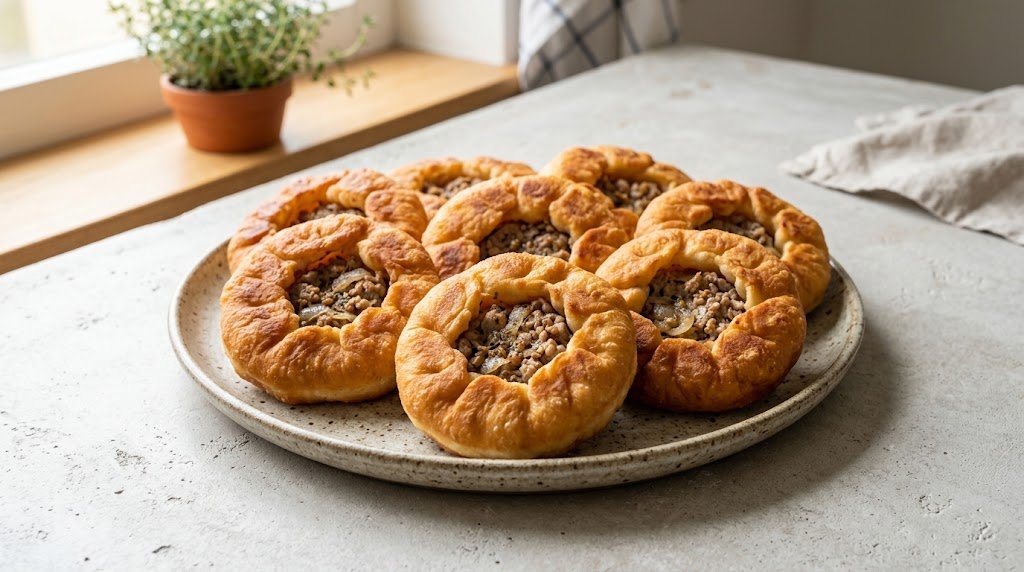
These homemade belyashi are round, golden fried meat pies with a soft, airy yeast dough and a juicy ground beef and onion filling. Each bun has a small opening in the center, giving the pies their distinctive shape and allowing you to check the filling as it cooks. The milk-enriched dough develops a light, tender crumb while the outside turns crisp in the frying pan. Serve them warm with a fresh cucumber salad, sour cream or a bowl of broth.
Belyashi are individual fried meat pies with a golden crust, soft yeast dough and a savory minced meat center. Closely related to Tatar peremech and widely eaten in Russia, they are a distinctive type of meat-filled fried bun. Unlike fully enclosed piroshki, this version has a small opening at the top surrounded by neatly pinched dough. The opening is part of the shape, not a substitute for checking the meat’s internal temperature. This recipe makes ten substantial pies with a milk-and-egg dough, grated onion and ground beef. Allow time for the dough to rise before shaping, then fry in manageable batches so the bread and filling cook together without the outside becoming too dark.
What makes belyashi different from other meat pies?
Belyashi have a distinct balance of bread and filling. The yeast-raised wrapper should be fluffy beneath its golden fried surface, while the onion keeps the meat center moist. The small opening and rounded shape connect this style to Tatar peremech, a regional fried pastry. This is a home-style beef adaptation using milk, egg and instant yeast rather than a claim that one formulation represents every tradition.
Recipe at a glance
Makes 10 medium-to-large belyashi. Allow 45 minutes for active preparation, approximately 90 minutes for rising and resting, and 45 minutes for frying in batches, for an estimated total of 3 hours. The first rise depends on room temperature and the final batches may take longer if the skillet is small. Preparation can overlap with rising. Timing and yield are editorial estimates rather than documented kitchen-test results.
Equipment
Digital scale, mixing bowl, spoon or dough scraper, clean cover, grater, separate bowl for raw beef, tray, deep heavy skillet (approximately 26–28 cm), frying thermometer, instant-read food thermometer, tongs or slotted spatula and wire rack set over a tray.
Choosing the ingredients
Flour, yeast and milk
Plain all-purpose flour provides enough structure to hold the filling while remaining tender. Instant yeast can be mixed directly into the flour, and the milk should be lukewarm rather than hot. Milk and egg soften the dough, while sugar supports browning and gives the crust a mild sweetness. Weigh the flour where possible because tightly packed cups can make a stiff dough. Start with the listed milk and egg, and add the optional water only if the dough needs it.
Ground beef and onion
Use moderately fatty beef, such as 85% lean, for a moist center. Finely grated onion distributes moisture throughout the meat and avoids large pieces that could puncture the dough. The filling should be soft enough to spread but not so wet that liquid collects in the bowl. Add cold water gradually instead of pouring in the original full 100 ml at once. The filling requires its own salt in addition to the salt used in the dough.
Frying oil
Choose a neutral refined oil suitable for high heat, such as canola or sunflower oil. Use enough for a shallow layer so the sides of each pie brown when turned. The quantity in the ingredient list is an approximate starting amount for the suggested skillet; most of it remains in the pan.
Recipe card
Belyashi Recipe with Juicy Beef and Soft Yeast Dough
Estimated times; rise until roughly doubled. Preparation can overlap rising, and batch frying depends on skillet size.
Equipment: Digital scale, mixing bowl, spoon or dough scraper, clean cover, grater, separate bowl for raw beef, tray, deep heavy skillet (approximately 26–28 cm), frying thermometer, instant-read food thermometer, tongs or slotted spatula and wire rack set over a tray.
Ingredients
Yeast dough
Beef filling
Frying
Instructions
Mix the yeast dough
Combine the flour, instant yeast, sugar and dough salt in a large bowl. Reserve a small portion of flour. Whisk the lukewarm milk with the egg, then pour into the dry ingredients and stir until a shaggy dough forms. Add reserved flour gradually; if the dough feels stiff, add up to two tablespoons of lukewarm water a teaspoon at a time.
Knead until elastic
Turn the dough onto a lightly floured surface and knead for 8–10 minutes, until it is smooth, stretchy and slightly tacky. Alternatively, use a dough hook on low speed. Resist adding excessive flour, which can make the fried buns dense. Shape into a ball.
10 minAllow the dough to rise
Place the dough in a lightly oiled bowl, cover and leave in a comfortably warm, draft-free place for about 60–75 minutes or until roughly doubled. A cool room may require longer. A gently pressed indentation should return slowly.
Prepare the beef filling
Finely grate the onion into a separate bowl and combine with the ground beef, filling salt and pepper. Add the cold water one tablespoon at a time, stopping when the mixture is moist but not runny. Cover and refrigerate. To check seasoning, fry a small sample to 71°C (160°F); never taste raw meat.
Divide and flatten the dough
Gently deflate the risen dough and divide into ten equal portions, approximately 85–90 g each depending on the amount of water used. Shape each into a ball. Cover the unused portions. Flatten each ball into a circle about 11–12 cm across, keeping the center slightly thicker than the edges.
Fill and pleat each belyash
Divide the beef filling into ten equal portions, approximately 45–50 g each. Place one portion in the center of a dough round and flatten it slightly. Gather the dough around the filling in small pleats, pinching them securely while leaving an opening about 1.5–2 cm across. Flatten gently to an even thickness, taking care not to tear the base.
Rest the shaped pies
Place the shaped pies opening-side up on a lightly floured tray and cover loosely. Rest for about 10–15 minutes until slightly puffy. Work in small batches and keep unused raw filling refrigerated. Do not let raw meat-filled buns stand at room temperature for extended periods.
15 minHeat the frying oil
Pour neutral oil into a deep, heavy skillet to a depth of about 1–1.5 cm. Heat over medium heat to 165–170°C (330–340°F). Use a frying thermometer and keep the skillet no more than half full. Make sure utensils and the exterior of the pies are dry before they touch hot oil.
Fry until golden and cooked through
Using a spatula, carefully lower two or three pies into the oil with the opening facing down, away from yourself to reduce splashing. Fry for about 5–6 minutes, turn carefully and fry the second side for another 5–6 minutes, adjusting the heat as needed. Check through the side into the center of the filling with an instant-read thermometer: ground beef must reach 71°C (160°F). If necessary, cook longer at reduced heat. Allow oil to recover between batches.
Drain and serve
Transfer cooked pies to a wire rack over a tray and rest briefly before serving, as the filling will be hot. Repeat with the remaining pies. Serve warm with sour cream, salad or broth. Cool and refrigerate leftovers promptly.
Nutrition per serving 340 kcal · protein 13 g · fat 12 g · carbs 44 g
How to tell when belyashi are ready
Look for an evenly golden-brown crust, a firm seam and dough that feels light rather than heavy. These signs do not prove the meat is cooked. Insert a clean instant-read thermometer from the side into the center of the thickest part of the filling. Ground beef must reach 71°C (160°F), as specified in the official minimum internal temperature chart. If the crust is browning faster than the interior, reduce the heat. You may finish the pies on a baking tray in a 160°C (325°F) oven, checking the meat temperature before serving.
Practical tips for light dough and juicy filling
- Weigh flour and add the last portion gradually. The dough should feel supple and slightly tacky, not hard or dry.
- Use lukewarm milk around 32–38°C (90–100°F) and instant yeast within its expiry date. Hot milk can damage the yeast.
- Let the dough roughly double in volume rather than relying solely on the clock; a cool kitchen requires more time.
- Grate the onion finely and add cold water to the filling gradually. Stop when the meat is moist but holds its shape.
- Keep the filling chilled and pat each shaped pie into an even thickness. Leave a small central opening and pinch the surrounding dough securely.
- Maintain oil at around 165–170°C (330–340°F). Fry in small batches and check the center of the beef filling reaches 71°C (160°F).
Troubleshooting common mistakes
- Dough does not rise: check yeast freshness and milk temperature, then allow extra time in a comfortably warm place.
- Dough tears: cover and rest for 10 minutes before stretching; avoid overly thin spots around the filling.
- Pies are dark outside but undercooked inside: lower the oil temperature, flatten the next pies slightly and cook longer; finish the current batch in a 160°C (325°F) oven until the center reaches 71°C (160°F).
- Pies absorb too much oil: maintain a steady frying temperature, avoid crowding and drain on a rack.
- Filling leaks: add water more gradually, keep raw filling off the dough edges and pinch the pleats firmly.
Substitutions
- Active dry yeast can replace instant yeast using the packet’s equivalent amount and activation directions.
- Whole or 2% milk works for the dough. Unsweetened plant milk can be tried, but browning and tenderness may differ.
- Ground lamb or a beef-and-lamb mixture can replace beef; cook ground red meat to 71°C (160°F).
- Ground chicken or turkey can be used, but its center must reach 74°C (165°F).
Recipe variations
- For a closed pie, gather and seal the dough completely; flatten gently and check internal temperature during frying.
- For a spiced filling, add a small pinch of ground cumin or finely chopped parsley to the beef and onion.
- For smaller snack-size belyashi, divide dough and filling into 14–16 equal portions and begin checking doneness earlier.
For a different shaping method, compare our closed belyashi with yeast dough. If you do not have time to proof dough, try the no-yeast kefir belyashi. For a meat-free alternative, explore fried cabbage pirozhki. Each uses its own dough and cooking method, so follow the relevant recipe rather than substituting without adjusting the technique.
What to serve with belyashi
A freshly fried belyash is filling enough to serve on its own. Fresh or pickled vegetables add brightness, while a cool dairy accompaniment contrasts with the hot crust. A simple broth makes a satisfying lunch or dinner without competing with the beef and onion flavors.
- Serve warm, straight from the rack, with sour cream or unsweetened plain yogurt.
- Pair with cucumber and tomato salad or pickled vegetables to contrast with the rich fried dough.
- Serve alongside a clear beef or vegetable broth for a more substantial meal.
- Offer freshly ground black pepper or a little chopped dill at the table.
Make ahead
Measure the flour, yeast and other dry ingredients before beginning. The ground beef mixture may be made earlier on the same day and kept covered in the refrigerator at 4°C (40°F) or colder. Bring out only the portion you are about to shape. It is preferable to freeze fully cooked pies for longer storage rather than leaving raw filled dough in the refrigerator for several days. Yeasted dough continues to change during storage, so its rise and texture may be less predictable if assembled far in advance.
Storage, freezing and reheating
Refrigerate cooked pies at 4°C (40°F) or colder within two hours, or one hour above 32°C (90°F). Use within three days. Freeze cooled cooked pies individually, then transfer to freezer bags and use within two months for best quality. Thaw in the refrigerator and reheat in an oven at 175°C (350°F) until the center reaches 74°C (165°F).
To restore the crisp surface, place thawed pies on a rack or baking tray in a preheated oven. Begin checking after about 10 minutes, allowing longer for larger pies. Microwaving can soften the crust, so oven reheating is preferable for texture. Verify the center temperature regardless of the reheating method.
Food safety and allergens
Contains wheat, milk and egg. Use separate utensils and work surfaces for raw meat and cooked pies. Wash hands after handling raw beef and dough. Keep perishable ingredients refrigerated and avoid leaving them at room temperature for more than two hours in total, or one hour in conditions above 32°C (90°F). When frying, never add water to hot oil, never leave the skillet unattended and turn the pies with a long-handled utensil.
Nutrition information
Estimated per pie: approximately 340 calories, 13 g protein, 44 g carbohydrate and 12 g fat. The calculation uses typical ingredient composition for the flour, whole milk, egg, sugar, yeast, onion and 85% lean ground beef, with an assumed absorption of 5 g frying oil per pie. Actual oil absorption is not measured and can vary considerably, as can the fat content of beef. Optional accompaniments are excluded.
Frequently asked questions
What is the difference between belyashi and piroshki?
Piroshki is a broad term for filled buns or pies, which can be baked or fried. Belyashi are a particular round fried meat-pie style closely related to Tatar peremech. Many versions have a small opening, though closed versions also exist.
Why do belyashi have a hole in the center?
The opening is a characteristic shape that exposes a small portion of the filling and lets steam escape. It does not ensure the beef is fully cooked, so always use a thermometer.
Do you cook the ground beef before shaping belyashi?
Not in this version. The seasoned beef and onion go into the dough raw and cook during frying. Keep the filling cold and check the center reaches 71°C (160°F).
Can I make belyashi without a stand mixer?
Yes. Mix with a spoon, then knead by hand until the dough is smooth and elastic. A short rest can make a sticky dough easier to handle.
Can I use a different ground meat?
Yes. Lamb or a beef-and-lamb mixture works well. Ground chicken or turkey is also possible, but poultry requires a higher internal temperature of 74°C (165°F).
Can I freeze cooked belyashi?
Yes. Cool promptly, freeze individually and transfer to an airtight bag. Thaw in the refrigerator and reheat in the oven until the center reaches 74°C (165°F).
Why are my fried pies greasy?
Oil that is too cool or a crowded skillet can slow frying and increase oil absorption. Keep the oil near 165–170°C (330–340°F), cook in small batches and drain on a rack.
Can I bake these instead of frying?
This formulation is intended for shallow frying. Baking changes the crust and timing. For oven-baked pies, use a dough and method specifically designed for baking rather than assuming the same frying instructions apply.
More recipes to try

Russian Pelmeni Recipe with Soft Buttermilk Dough

Turkey Jambalaya with Rice, Corn and Crispy Bacon

Otbivnaya Chicken Tenders with a Crisp Pan Fried Coating
Easy Mushroom Gravy with Browned Mushrooms and Thyme
Chicken and Vegetable Skewers with Lemon Herb Marinade
Pan Seared Trout with Parsley and Lemon Butter
Spotted a detail that needs correcting? Contact the FeastDelights editors.