Ukrainian Makivnyk Poppy Seed Roll with Honey
Makivnyk is a Ukrainian-style sweet yeast roll with a dark spiral of ground poppy seeds, honey and vanilla. The milk and butter dough bakes to a soft crumb around the pleasantly grainy filling. Soak and drain the seeds carefully, then spread the paste across a thin rectangle of dough before rolling and sealing it. Allow just over three hours for mixing, two rises and baking, plus cooling before slicing. One large roll makes approximately twelve slices for tea or a festive dessert table.
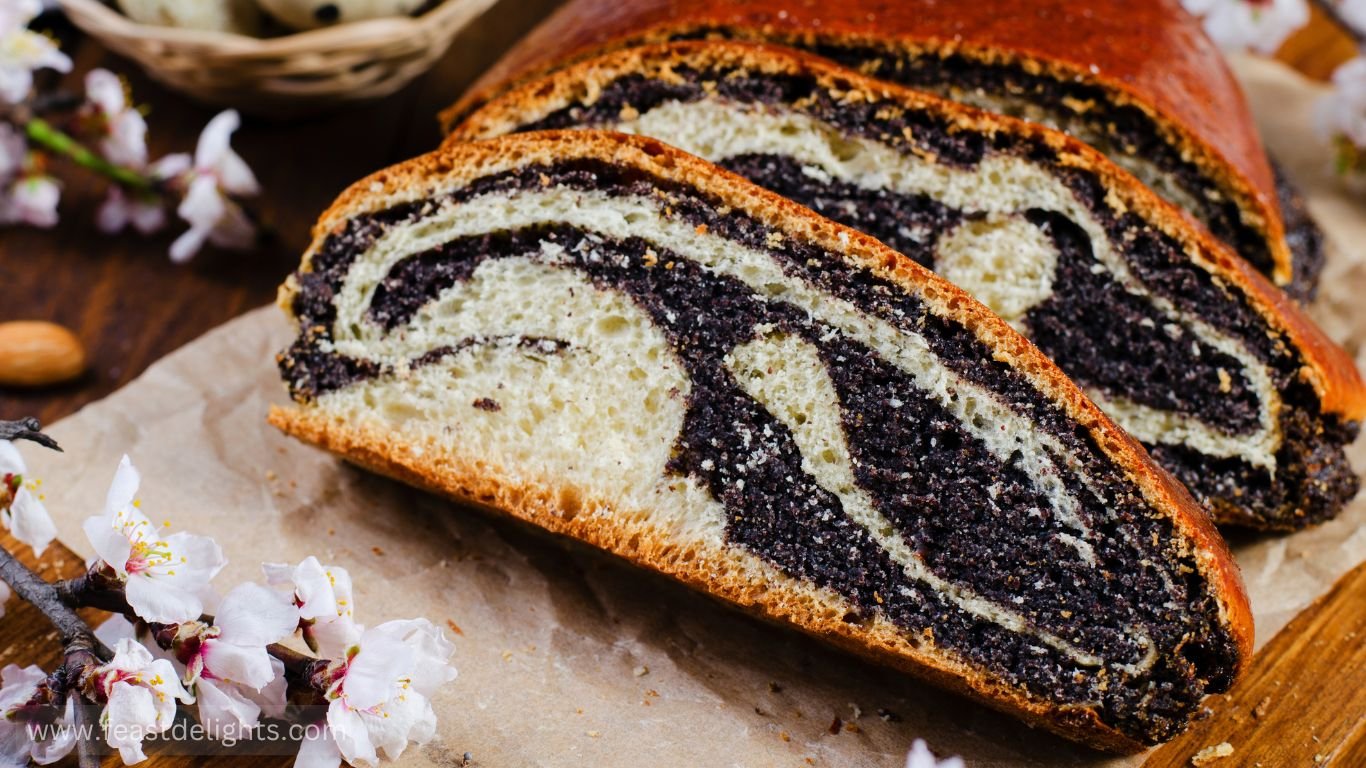
This makivnyk poppy seed roll pairs a lightly sweet, enriched yeast dough with a generous ground poppy seed and honey filling. It is a rolled bread rather than a sponge cake. The defining feature is the dark spiral visible in each slice. Plan for a long first rise and a shorter second proof, and let the loaf cool before cutting.
What makes makivnyk different from a plain sweet loaf?
The ground poppy seeds give this bread a nutty, earthy flavour that contrasts with the mild milk dough. Honey softens the taste of the seeds and helps bind the paste. Unlike a loaf with a few seeds scattered through the crumb, this version keeps almost all of the poppy seeds in a separate layer. The amount of filling is substantial, so draining, rolling and sealing matter as much as the dough itself.
Sweet rolls with poppy seed fillings appear in several Central and Eastern European baking traditions. This Ukrainian-style version uses a soft risen dough, honey and vanilla sugar. It is not intended to represent every regional version. For another poppy seed preparation, see our buttery vanilla poppy seed filling.
Ingredients that influence the dough
All-purpose flour gives a soft but workable dough. Weigh the 500 g rather than scooping it with a cup: compacted flour makes bread dry. The milk should feel lukewarm, not hot. Excessive heat can damage yeast. Eggs contribute richness, and butter makes the crumb tender. Let melted butter cool so that it does not heat the yeast mixture.
Sugar is present in both components. In the dough, its relatively high proportion means fermentation can be slower than in a plain loaf. In the filling, sugar and honey balance the distinctive poppy flavour. Vanilla sugar is a convenient way to flavour both without adding extra liquid. If yours comes in packets, measure the specified teaspoon rather than assuming every packet has the same weight.
Making a spreadable poppy seed filling
Use food-grade culinary poppy seeds. Soaking in hot milk softens them for grinding, but milk remaining in the sieve should not be tipped back in automatically. A filling that pours or releases liquid will seep out of the seam as the roll expands. After draining, grind until the mixture resembles a coarse paste. Stop to scrape the grinder only when it is switched off. Small batches may work better than overloading the bowl.
The honey and sugar make the ground seeds cohesive. The paste should spread gently without puddling or tearing the dough. Allow the mixture to cool before rolling; warm filling may soften the dough and make shaping difficult. Optional raisins and nuts add contrast but also bulk. If using both, distribute them evenly rather than gathering them in one thick line. For a different flavour profile, our honey and lemon poppy seed filling is a separate preparation.
Equipment and timing
Have a large mixing bowl, kitchen scale, fine sieve, saucepan, suitable seed grinder, rolling pin, parchment-lined baking tray and wire rack ready. The tray needs to hold the finished log with room to expand. Plan on approximately 45 minutes of active preparation, up to 110 minutes for the two rises, and 40 minutes of baking. Make the filling during the first rise, not after it. Cooling time is additional; allow the loaf to cool before serving.
Recipe card
Ukrainian Makivnyk Poppy Seed Roll with Honey
First rise 60–90 minutes; second rise about 20 minutes. Filling soaks during first rise. Total allows the longer rise; cooling is additional.
Equipment: Large bowl; kitchen scale; saucepan; fine sieve; seed grinder or processor; rolling pin; parchment; baking tray; wire rack; serrated knife
Ingredients
Yeast dough
Poppy seed filling
Optional additions
Instructions
Activate the yeast
Use a small portion of the 250 ml dough milk, warmed to about 38°C (100°F), and a teaspoon of the measured dough sugar. Stir in the dry yeast and leave for 5–10 minutes until it shows activity. Follow packet directions if using instant yeast.
Mix and knead the dough
Combine flour, remaining milk and sugar, eggs, vanilla sugar, salt and yeast mixture. Knead until the dough begins to come together, then work in melted, cooled butter. Continue until supple and elastic, roughly 8–12 minutes depending on technique. Cover and leave in a comfortably warm place for 60–90 minutes, until roughly doubled.
Prepare the poppy seed paste
During the first rise, pour hot filling milk over the poppy seeds. Soak for 30 minutes, then drain in a fine sieve. Grind the softened seeds in a suitable grinder or food processor with the filling sugar, honey and vanilla sugar until a thick spreadable paste forms. Mix in optional raisins or nuts, if using. Let cool before spreading.
Roll and fill
Gently deflate the dough on a lightly floured surface. Roll to a rectangle about 5 mm (¼ inch) thick, with one side short enough to fit the baking tray. Spread the filling evenly, leaving a 2 cm (¾ inch) border. Roll from the edge that gives a tray-length log, snugly but without pulling the dough tight. Pinch the seam and ends closed.
Proof the shaped roll
Place seam-side down on a parchment-lined tray. Cover lightly and let rest for about 20 minutes, or until visibly puffy. Preheat the oven to 180°C (350°F) during this rest.
Bake until the dough is set
Bake for 30–40 minutes, checking at 30 minutes. The crust should be evenly golden, the seam set and the bread layers cooked through. A thin probe in a dough-rich part should read around 90–93°C (194–199°F) as a baking cue; avoid measuring only the moist filling. If the crust browns too early, shield loosely with foil and continue until the dough is done.
Cool and slice
Transfer carefully to a wire rack and cool before cutting. Use a serrated knife with a gentle sawing motion to avoid compressing the spiral.
How to judge the dough rather than the clock
At first the mixture may feel sticky. Knead before deciding that more flour is needed, since the flour continues absorbing milk while you work. A scraper can help lift sticky dough from the work surface. Once kneaded, it should feel smooth and stretch without immediately tearing. It does not have to be completely dry to the touch. Too much flour changes the balance of milk, fat and flour and makes a tougher roll.
Cover the bowl to prevent a dry skin while the yeast works. A warm, draught-free place helps, but avoid a hot oven. The first rise is ready when the dough has visibly expanded to roughly twice its starting volume. If it has barely risen after the suggested time, give it longer rather than proceeding automatically. If there is no sign of activity, check the yeast and milk temperature before attempting to rescue the dough.
Rolling a clean spiral
After the first rise, press out the largest pockets of gas gently. Roll to an even thickness of around half a centimetre. If the dough springs back, let it rest a few minutes, covered, then continue. A rectangle that is very thin in places may rupture under the filling.
Spread the poppy mixture in an even layer, leaving the edges clean. Start rolling with a small fold that holds the filling inside. Continue with light pressure so the layers stay close but the dough is not stretched. Leave the final seam free of seeds, pinch it closed and tuck the ends in. Transfer with both hands supporting the log; do not lift it by one end. The final short proof allows the shaped bread to expand before oven heat sets the crust.
How to tell when the roll is baked
Golden colour alone is not sufficient because a sweet dough can brown before the centre is ready. Check the thickest section, especially where the dough overlaps near the seam. If using a probe, aim for a dough layer rather than the wet poppy seed paste. Around 90–93°C (194–199°F) is a useful bread-doneness cue, not a guarantee of the exact bake time. If the outside becomes dark early, cover it loosely with foil. Do not slice hot bread to check the middle unless necessary; the steam and tender crumb can make a fully baked loaf appear gummy.
Troubleshooting common problems
Filling leaks from the ends: the paste may be too wet or the ends were not fully sealed. Drain the seeds thoroughly, leave the clean border and pinch the dough firmly together.
Large air gaps between layers: roll the dough snugly without trapping large pockets of air or leaving thick ridges of filling. Avoid coating the inner face with loose flour before rolling.
Crumb is dry: weigh the flour and avoid prolonged baking once the bread is done. A thin crust may be slightly crisp on cooling, but the interior should remain soft.
Spiral smears when cut: let the roll cool on a rack. Use a serrated knife and gentle strokes instead of pressing straight down.
Serving, variations and allergens
Serve slices with tea or coffee or include them alongside other celebration desserts. For a festive table, a different poppy seed dish is our Ukrainian Christmas kutia. Optional raisins bring little pockets of fruit sweetness; chopped nuts make the filling more textured. Keep these additions moderate so the roll still seals. The recipe contains wheat, milk and eggs. Optional nuts introduce another major allergen; check packaged ingredients and shared equipment for cross-contact.
Make ahead and storage
Weigh the dry ingredients in advance and keep the milk and eggs refrigerated. Preparing the filling during the first rise is the simplest approach. Avoid tasting raw dough containing flour and eggs. If making the filling earlier, cool it promptly and refrigerate in a covered container until needed the same day.
Cool completely before wrapping. Because this filling contains milk and its keeping quality has not been tested, refrigerate the wrapped roll within two hours at 4°C (40°F) or colder and use within two days. Freeze individually wrapped slices for up to two months for best quality. Thaw in the refrigerator and warm briefly if desired.
Slice across the cooled roll with a serrated knife to reveal the poppy seed spiral. A well-drained filling and a relaxed, properly risen dough are the keys to a neat slice.
Frequently asked questions
Is makivnyk a cake or a bread?
This version is an enriched yeast bread rolled around a poppy seed paste, rather than a sponge cake.
Can I skip grinding the seeds?
Whole seeds do not form the same cohesive paste. A suitable grinder helps release their flavour and gives the filling a texture that spreads evenly.
Why is the dough rising slowly?
Milk, butter, eggs and sugar make an enriched dough that may rise more slowly than plain bread dough. Check the yeast is fresh and give the dough time in a comfortably warm place.
Can I use a ready-made filling?
You can try a thick bakery-style poppy seed paste, but its sweetness and moisture may differ. The stated quantities apply to the homemade filling.
Why did the roll split?
Wet filling, tightly stretched dough or insufficient final proof may contribute. Drain well, leave a border, seal and allow the shaped dough to puff before baking.
Can I omit the raisins and nuts?
Yes. Both are optional; leave them out without changing the base filling quantities.
Why should the roll cool before slicing?
The bread and filling are fragile while hot. Cooling allows the crumb to settle and helps maintain the spiral.
More recipes to try






Spotted a detail that needs correcting? Contact the FeastDelights editors.