Chicken Pot Pie with Puff Pastry and Creamy Filling
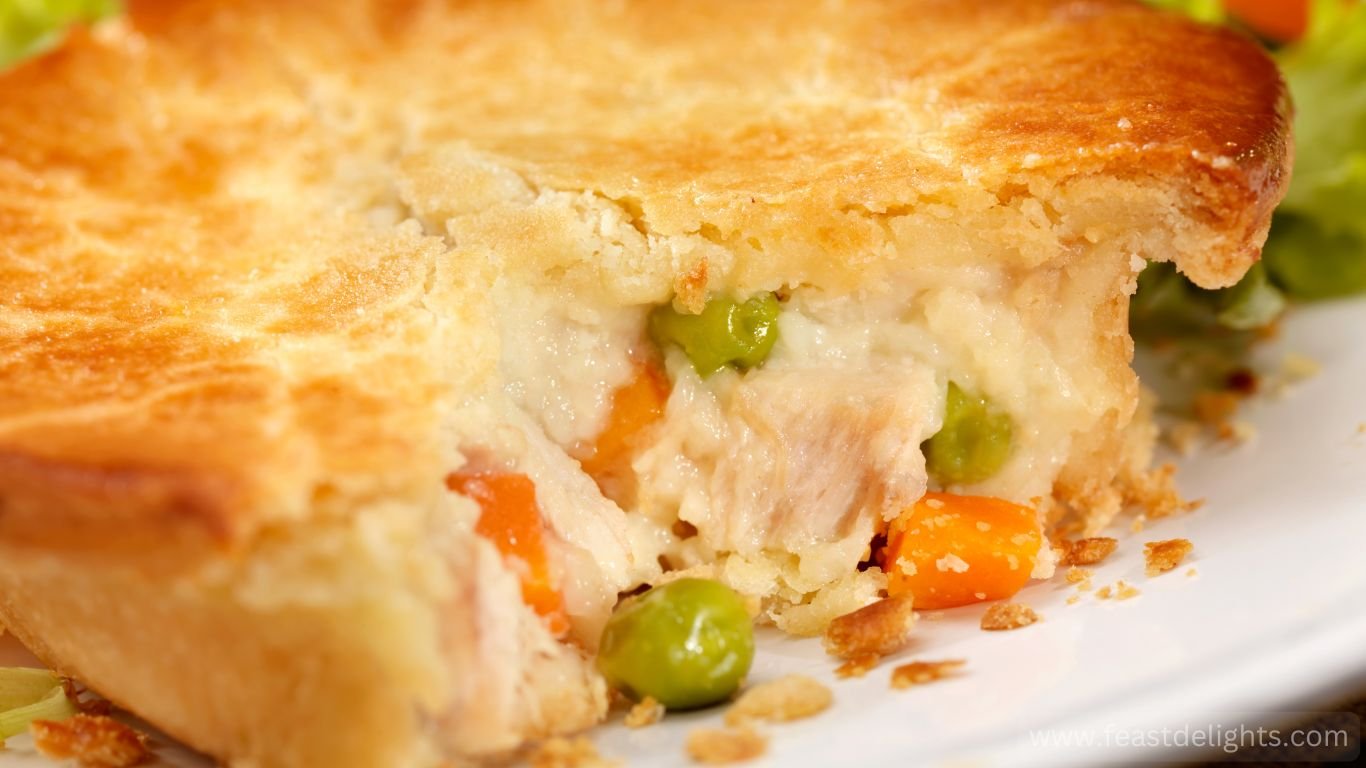
This chicken pot pie combines tender diced chicken, carrots, peas, onion and celery in a creamy, flour-thickened sauce beneath a golden puff pastry lid. It makes six portions and uses a single sheet of pastry rather than a bottom crust, so the filling stays the focus. Allow about 95 minutes including stovetop cooking, a short cooling period, baking and resting. Keep the pastry cold until assembly, simmer the gravy until it coats a spoon and check the chicken with a food thermometer.
What makes a good chicken pot pie?
This is a family-style pie with one flaky puff pastry lid over a creamy chicken and vegetable filling. Unlike a fully enclosed pie, it is served by spooning the gravy and vegetables from a baking dish. The existing recipe’s chicken, vegetables, butter, flour, milk and stock proportions remain unchanged. The updated method gives the filling more room to bubble and explicitly counts the cooling and resting periods.
Ingredients and their roles
Boneless chicken breast provides lean, mild pieces of meat, while thigh meat stays juicy during the two cooking stages. Cut either into similar pieces so they reach a safe temperature at approximately the same time. Onion and celery add savoury depth; carrot and peas balance the sauce with sweetness. Keep frozen peas in the freezer until the filling is nearly finished so they retain colour.
Butter and flour are the starting point for the thickened gravy. When the flour is stirred into the cooked vegetables and pan fat, it forms a roux-like base. Cook it briefly before adding liquid to avoid a raw flour taste. Stock supplies savoury flavour and milk makes the sauce creamy without requiring heavy cream. Use reduced-salt stock if possible because seasoning concentrates as the gravy simmers. Puff pastry supplies the crisp lid; thaw it according to the package and keep it refrigerated until you need it.
Preparing the dish and pastry
Choose an oven-safe dish that holds the entire filling with room above it. A two-litre dish is a safer starting point than the previous 1.5-litre recommendation for these quantities, but the actual volume depends on vegetable sizes. A shallow dish exposes more pastry surface to oven heat. Place it on a rimmed tray to catch drips. The pastry sheet should be large enough to cover the opening with a little overhang; roll gently only if necessary.
Use a separate cutting board for raw chicken, wash hands and utensils afterwards and do not rinse raw poultry. Cook the chicken fully before setting it aside. A thermometer inserted into the thickest pieces should read at least 74°C (165°F), consistent with official minimum-temperature guidance.
Recipe card
Chicken Pot Pie with Puff Pastry and Creamy Filling
Includes about 15–25 minutes stovetop cooking, 25–35 minutes baking (50 minutes combined estimate), 10 minutes cooling before topping and 10 minutes resting after baking. Allow longer if needed to reach safe temperatures.
Equipment: Kitchen scale, measuring jug, separate raw-chicken cutting board, chef's knife, large deep skillet, whisk, 2-litre (about 2 US quart) oven-safe baking dish or larger if needed, baking tray, pastry brush, instant-read thermometer
Ingredients
Chicken and vegetable filling
Pastry lid
Instructions
Cook the chicken through
Preheat a conventional oven to 200°C (400°F). Dice chicken into even pieces. Melt butter over medium heat in a large skillet and cook the chicken, turning, until the thickest pieces reach 74°C (165°F). Transfer to a clean plate; do not reuse a plate that held raw poultry.
Soften the aromatic vegetables
In the same skillet, cook onion, carrot and celery about 5 minutes, stirring, until the onion is translucent and carrot begins to soften. Reduce heat if the butter or pan juices darken too quickly.
Prepare the creamy gravy
Stir in the flour and cook for 1 minute. Add stock gradually, whisking to avoid lumps, then add milk. Simmer gently for 4–6 minutes or until the sauce coats a spoon. Add a splash of stock only if it becomes excessively thick.
Combine and cool the filling briefly
Stir in frozen peas and cooked chicken, then season with pepper and salt to taste. Transfer to a roughly 2-litre oven-safe dish, leaving at least 2 cm headroom; use a larger dish if needed. Let stand about 10 minutes until the strongest steam subsides.
Add the cold pastry lid
Keep puff pastry chilled until needed. Lay it over the filling, trim to fit with a small overhang and press onto the rim. Cut several steam vents, brush the top lightly with beaten egg without flooding the cut edges, and place the dish on a rimmed baking tray.
Bake until golden and rest
Bake 25–35 minutes on the middle rack until the lid is deeply golden and the filling bubbles at the vents. Check the centre reaches 74°C (165°F). If the crust browns early, shield loosely with foil while the filling finishes heating. Rest 10 minutes before serving.
How to judge sauce consistency
After the stock and milk have simmered, dip a spoon into the sauce. It should leave a thin but visible coating rather than running off like broth. A trail drawn with a clean spoon across the pan should close slowly. The filling will thicken slightly as it cools, so do not reduce it to a paste. If it is very thick, stir in stock a tablespoon at a time; if watery, simmer uncovered before adding the pastry. Avoid adding uncooked flour directly into a finished sauce, where it can form lumps.
How to bake a crisp lid
Let the hot filling stand briefly until it is no longer releasing clouds of steam. That gives the chilled pastry a better chance of retaining its layers before reaching the oven. Cover the dish without stretching the pastry tightly; dough can shrink as it bakes. Cut vents so excess steam can escape. Brush egg only over the top, as egg pooling around cut edges can interfere with the pastry layers. Do not rely on the first golden patch: wait for a well-browned lid, bubbling gravy and a hot centre. A chilled filling may need additional baking time.
Troubleshooting
If the chicken tastes dry, check whether it was cooked far beyond its safe temperature on the stove before being baked again. Thigh meat tolerates longer heating more readily. If the sauce separates, reduce heat during simmering and whisk gently. A watery filling may result from large amounts of frozen vegetables added too early. If pastry darkens before the centre is hot, tent it loosely with foil and continue cooking until the filling is safe to serve. Do not seal the foil tightly, which traps steam.
Substitutions and variations
Cooked turkey or leftover chicken can replace the raw diced chicken, provided it has been stored safely. Add the cooked meat near the end of preparing the gravy instead of browning it again. Chopped thyme or a little parsley can complement the stock. Mushrooms are useful if sautéed first to evaporate their moisture. Plant milk and dairy-free pastry may work for a dairy-free adaptation, but choose an unsweetened product and verify the stock and pastry labels. The thickening performance can vary. A gluten-free adaptation needs suitable flour, pastry and verified stock rather than a simple flour swap alone.
Serving ideas
Because the filling is rich, a lightly dressed salad or bright vegetable side is enough. Try garlic green beans with lemon and herbs or a cauliflower and cucumber salad. For a bowl-based alternative with similar flavours, see chicken pot pie soup with puff pastry squares; its broth and separate pastry are a different preparation.
Make ahead, freezing and food safety
Prepare the filling ahead if desired, but cool it in shallow containers and refrigerate promptly rather than leaving a large hot casserole at room temperature. Add the pastry shortly before baking. Frozen filling should be thawed in the refrigerator. Portion baked leftovers promptly and follow the storage limits in the recipe card. The USDA leftover guidance recommends refrigeration within two hours, sooner in hot conditions, and reheating to a safe temperature. The conservative three-day limit used here falls within the official refrigerated window.
This recipe contains wheat, milk, egg and celery. Some commercial stocks contain additional allergens such as soy; read labels carefully. Check pastry ingredients even when the packaging says it is plant-based. Keep the unused raw egg glaze separate from cooked food and discard it after assembly.
Frequently asked questions
Can I use cooked leftover chicken?
Yes. Use a similar amount of cooked chicken, refrigerate it safely beforehand and add it when combining the filling. Heat the finished pie to 74°C (165°F); count storage time from when the chicken was originally cooked.
Why is my pot pie filling runny?
The flour-thickened sauce may not have simmered long enough or the vegetables released excess water. Simmer until it coats a spoon before assembly and rest the baked pie.
Why did my puff pastry fail to rise?
Warm pastry, a very hot filling or an insufficiently preheated oven may soften the laminated layers. Cool the filling briefly and keep the sheet refrigerated until needed.
Can I use shortcrust pastry?
Yes, a ready-made shortcrust lid is an alternative, but its texture and baking time differ. Follow its package guidance and check the filling temperature.
Can I make the filling ahead?
Yes. Cool in shallow containers and refrigerate promptly. Assemble with cold pastry the next day; baking may take longer from chilled.
Can chicken pot pie be frozen?
Yes. Freeze cooled filling or baked portions in suitable airtight containers. Thaw in the refrigerator and reheat to 74°C (165°F). The pastry may soften after freezing.
How do I avoid a soggy pastry underside?
Use a sufficiently thick filling, allow the initial steam to subside and cut vents. Bake until the pastry is fully golden rather than removing it as soon as the top colours.
More recipes to try






Spotted a detail that needs correcting? Contact the FeastDelights editors.