Rose Petal Jam Recipe for Refrigerator Storage
This rose petal jam recipe suspends fragrant edible petals in a bright lemon-sugar syrup.
This rose petal jam recipe suspends fragrant edible petals in a bright lemon-sugar syrup. It is a small refrigerator batch rather than a shelf-stable preserve. Use culinary roses grown without pesticide residues, never florist blooms or unidentified garden flowers. The petals soften as they simmer, while lemon keeps the flavor from becoming flat. The result is usually a loose spoonable preserve rather than a firm commercial gel; its fragrance and color depend on the rose variety.
What matters for rose petal jam
Choose fragrant food-grade petals and trim bitter pale bases if noticeable. Rinse gently and shake dry. Fresh petal weights can vary dramatically by variety, so weigh the prepared petals rather than counting flowers. Lemon is included for flavor and color, not as a claim that this batch meets a validated canning acidity.
Recipe at a glance
Yield: about 350 g jam. Preparation: about 20 minutes. Cooking: about 25 minutes. Total elapsed time: about 90 minutes. Includes about 45 minutes for the resting, rising, cooling or chilling described below.
How to make rose petal jam
Recipe card
Rose Petal Jam Recipe for Refrigerator Storage
Equipment: Saucepan; scale; spoon; clean small heatproof containers.
Ingredients
Main
Instructions
Prepare edible petals
Check the roses are positively identified, food-grade and free from unsuitable sprays. Remove insects and tough bases, rinse petals gently and drain well.
Massage with sugar
Rub petals lightly with 50 g of the sugar and 1 tbsp lemon juice until softened and fragrant. Do not crush into a paste.
Make syrup
Heat remaining 200 g sugar with water in a saucepan, stirring until dissolved. Simmer 5 minutes.
Cook petals
Add petals and all their juices. Simmer gently 15–20 minutes, stirring occasionally, until petals are tender and syrup coats a spoon. Add remaining lemon juice. Remember it thickens further on cooling; do not chase a very stiff set.
Cool and refrigerate
Transfer to clean small heatproof containers. Cool promptly and refrigerate within 2 hours. The 45-minute cooling allowance is not a room-temperature preservation process. Keep refrigerated.
How to tell when it is ready
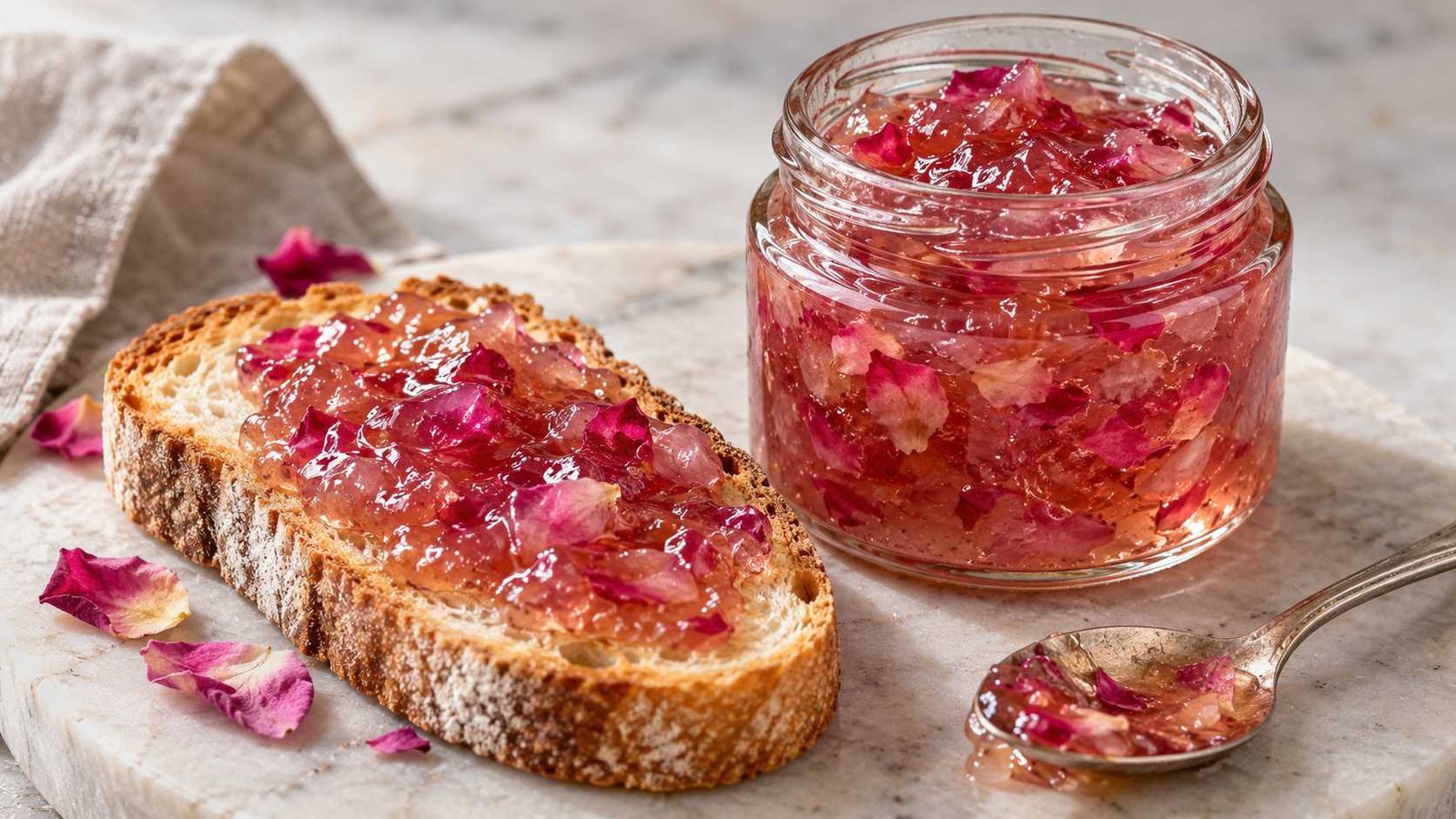
Tender petals remain visible in a glossy syrup that thickens slightly when cool.
Tips
- Use only food-grade roses.
- Remove bitter bases when present.
- Simmer gently.
- Expect a loose preserve.
Troubleshooting
- Weak fragrance: choose a more fragrant culinary variety.
- Too thick: loosen with a little hot water.
- Bitter: verify petal variety and trim pale bases.
Substitutions
- Do not replace with florist petals.
- Food-grade rosewater can enhance fragrance after cooking, starting with ¼ tsp.
Variations
- Add a small strip of lemon zest during simmering and remove before storage.
Serving suggestions
- Spoon onto toast.
- Serve beside plain yogurt.
- Pair with tea.
- Use sparingly over vanilla desserts.
Make ahead
Prepare on the day fresh edible petals are obtained for the best fragrance.
Storage
Refrigerate and use within 7 days, using a clean spoon. Freeze small portions up to 2 months for quality. This is not a validated canning recipe and must not be stored in a cupboard.
Food safety
Keep perishable ingredients at 4°C/40°F or below. Refrigerate perishable leftovers within 2 hours, or within 1 hour above 32°C/90°F. Use clean equipment and separate raw animal ingredients from ready-to-eat food.
Frequently asked questions
Can I use any rose?
No. Use positively identified culinary roses with suitable growing and handling history.
Will it set like strawberry jam?
Not necessarily. This recipe intentionally makes a loose petal preserve without added pectin.
More recipes to try



Spotted a detail that needs correcting? Contact the FeastDelights editors.