French Almond Macarons with Vanilla Ganache
These French almond macarons pair delicate almond-meringue shells with a smooth white-chocolate vanilla ganache. The shells should have rounded tops, ruffled feet and a lightly chewy interior. Weigh the ingredients, fold the batter until it flows in a slow ribbon, pipe even rounds and let their surfaces dry before baking. The recipe makes about 20 filled macarons in roughly 3 hours 15 minutes, with an optional overnight refrigerated rest to soften the shells slightly. Oven and ganache consistency require careful checking.
French almond macarons are small sandwich cookies with a thin, crisp surface, a tender chewy centre and a ruffled edge called a foot. This version uses French-style whipped egg whites and an almond-sugar mixture, then fills the baked shells with white-chocolate vanilla ganache. It makes about 20 filled macarons, depending on piping size. Allow roughly 3 hours 15 minutes to prepare, dry, bake, cool and fill the shells, plus an optional overnight refrigerated rest for the best texture. A scale and careful mixing are essential.
Macarons and macaroons are different cookies
Despite the similar names, macarons are almond-based meringue sandwich cookies, while coconut macaroons are typically small coconut-rich mounds. This recipe is for the French-style almond cookie. Its defining features are two thin shells, a slightly chewy middle and a filling that brings the shells together. The frilly ring around the base of each shell is called the foot. It forms as the batter expands during baking, but a tall foot alone is not proof that the centre is baked.
There are several ways to make the meringue. This version preserves the original French method, adding granulated sugar directly to whipping egg whites rather than cooking a syrup. The ingredient ratios are particular to this recipe. Do not mix them with a different macaron method or assume that changing the amount of sugar affects only sweetness; sugar also changes batter stability, drying and shell structure.
Weigh the shell ingredients
Use finely ground blanched almond flour rather than coarse ground almonds or wheat flour. Fine flour gives a smoother surface. Measure the 100 g almond flour and 180 g icing sugar before sifting. Break up soft clumps and discard only coarse particles that will not pass through the sieve; if you lose a substantial amount of almond flour, weigh again and replenish with finely sifted flour. Do not grind almonds for long periods in a processor, which can release oil.
The recipe uses 100 g egg whites, not a fixed number of eggs. Three large whites may be close, but weights vary. Separate eggs individually into a clean small bowl so one broken yolk cannot spoil the entire batch. Use a clean glass or metal mixing bowl and grease-free whisk. A small amount of yolk or fat can interfere with the foam. Bring the measured whites towards room temperature only briefly before mixing and avoid leaving them unrefrigerated for extended periods.
Granulated sugar is the sugar whipped into the whites; icing sugar, also called powdered or confectioners’ sugar, is sifted with the almonds. They serve different functions. Cream of tartar helps stabilise the foam. Gel colouring is optional and should be used sparingly, because too much additional liquid may change batter consistency. The shells can be left their natural pale almond colour.
Make the white-chocolate ganache first
Finely chop 100 g white chocolate made with cocoa butter. Heat 60 ml heavy cream in a small saucepan until steaming but not boiling vigorously. Pour over the chocolate and leave for about two minutes. Stir gently from the centre until the mixture becomes smooth, then add vanilla. If pieces remain unmelted, warm the bowl gently in short intervals, stirring each time; avoid overheating the chocolate.
White chocolate varies substantially in cocoa butter content. The stored 100 g chocolate to 60 ml cream formula makes a relatively soft ganache; its ability to hold a neat piped shape needs confirmation with your chosen chocolate. Chill promptly in a covered shallow bowl and check after it firms. It should hold a small mound without running when spooned or piped. If it is still fluid when cold, do not fill the shells yet. As a rescue, melt a little additional white chocolate separately and emulsify it gradually into gently warmed ganache, then chill again. This changes the original formula, so record the amount if you do it. Avoid adding powdered sugar simply to stiffen ganache, as it can change the texture.
Whip a stable French meringue
Beat the measured egg whites and cream of tartar at medium speed until foamy, then continue to soft peaks. A soft peak bends over when the whisk is lifted. Add the 50 g granulated sugar gradually rather than all at once; allow each addition to disperse. Increase the speed as needed until the mixture looks glossy and holds firm peaks. If colouring is used, add a small amount near the end.
Check the foam frequently near the final stage. It should hold its shape without looking grainy or dry. Stop once the peaks stand with enough firmness to support the almond mixture. A dry, clumpy meringue is harder to fold evenly. If the whites never build volume, check that the bowl and whisk were free from fat and that the sugar was added gradually. Avoid trying to correct a failed meringue with extra almond flour.
Macaronage: fold to the right consistency
Macaronage is the folding stage that combines the almond and icing sugar mixture with the meringue and releases some of the trapped air. Begin by folding the dry mixture into the whites in additions, scraping around the edge and through the centre of the bowl. When there are no dry streaks, gently press some batter against the side with the spatula, scrape it back and repeat as needed.
Lift a little batter after every few folds. It should fall back in a thick, continuous ribbon, then slowly merge with the rest of the batter. The original recipe uses about ten seconds as a guide, not a strict timer. If it falls in lumps that hold sharp peaks, it needs a little more folding. If it runs like thin pancake batter, it has gone too far. Overmixed batter cannot reliably be returned to its original structure by adding dry ingredients. Stop when the ribbon settles gradually and the batter remains thick enough to pipe a round that holds its shape. For further technique context, see King Arthur Baking’s macaronage guidance.
Pipe evenly and dry the surface
Line flat baking trays with parchment or a suitable macaron baking mat. If using a circle template beneath parchment, remove it before baking. Transfer the batter to a piping bag fitted with a plain round nozzle. Hold the bag upright with the tip close to the sheet; pipe roughly 3 cm (1¼ inch) circles, leaving space between them. Stop squeezing before lifting the tip. The small peak should gradually flatten.
Tap the tray on a stable surface a few times to release large air bubbles. Use a clean toothpick to open obvious remaining bubbles on the surface. Rest the piped rounds uncovered in a dry place for about 30–60 minutes. In a humid kitchen it may take longer. Touch one gently with a clean dry fingertip: the surface should feel dry rather than sticky. Do not force drying with a hot oven or leave egg-containing batter standing indefinitely. If conditions prevent the shells drying within a reasonable time, review the batch rather than assuming the original schedule still applies.
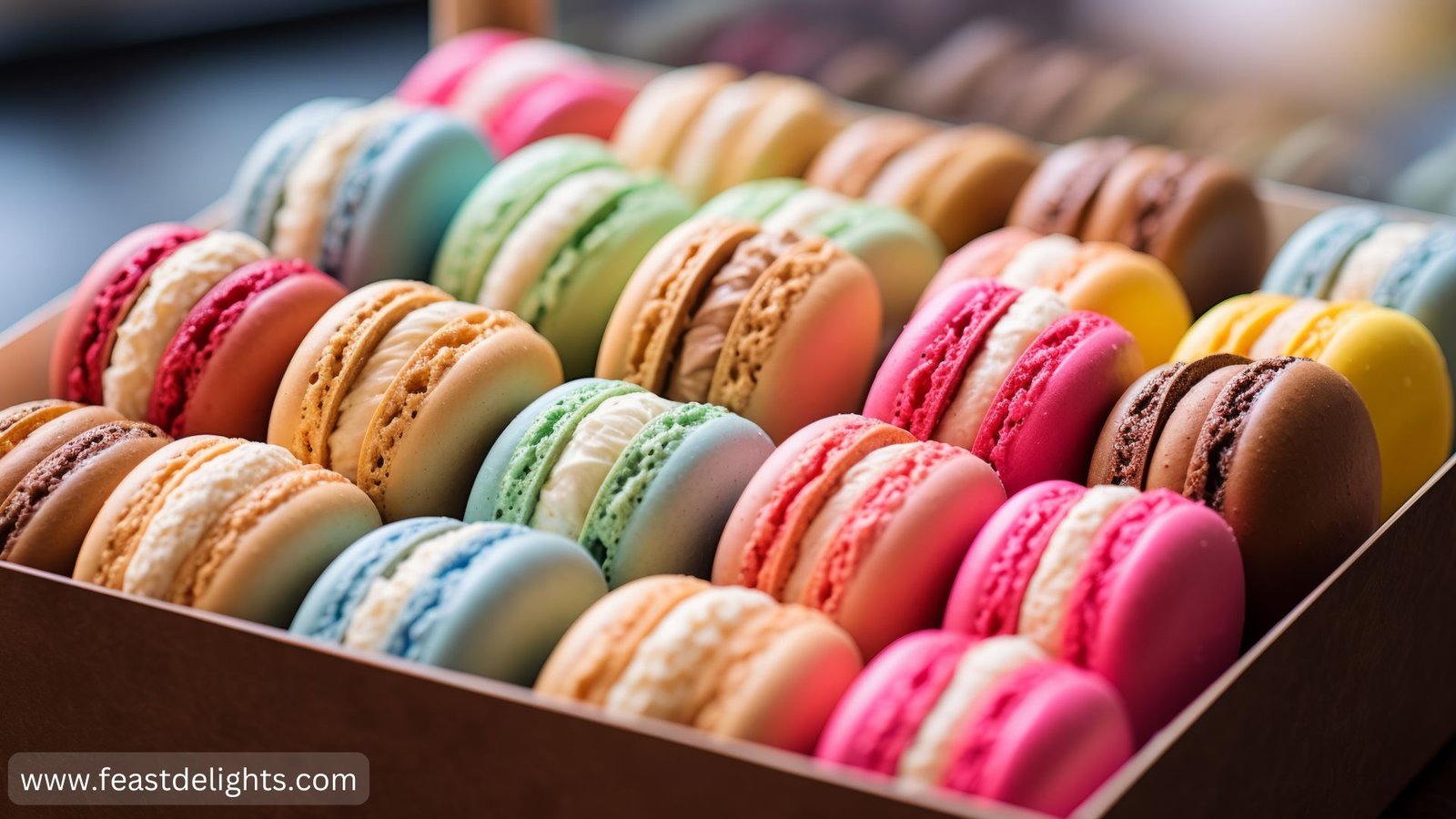
Recipe card
French Almond Macarons with Vanilla Ganache
About 45 minutes active prep, up to 32 minutes baking two trays, and around 120 minutes combined waiting (ganache chilling overlaps shell preparation; drying about 30–60 minutes and cooling as needed). Optional overnight refrigerated maturation is not included. Confirm ganache firmness and oven performance in a kitchen test.
Equipment: Digital kitchen scale, fine sieve, grease-free bowl, electric mixer, flexible spatula, piping bags and plain nozzle, flat baking trays, parchment or macaron mats, small saucepan, cooling rack and optional oven thermometer.
Ingredients
Almond shells
Vanilla ganache
Instructions
Make and chill the vanilla ganache
Put finely chopped white chocolate in a bowl. Heat cream until steaming, pour over chocolate, rest 2 minutes, then stir gently until smooth. Add vanilla and refrigerate promptly until pipeable and able to hold a mound.
Sift the almond mixture
Sift almond flour and icing sugar together twice. Discard coarse particles; replenish with sifted flour if a substantial amount is lost. Line flat trays with parchment.
Whip French meringue
In a grease-free bowl, beat egg whites with cream of tartar to soft peaks. Gradually add granulated sugar, beating to glossy firm peaks; add a little gel colouring if desired. Do not beat until dry.
Fold the batter (macaronage)
Fold the almond mixture into the meringue. Scrape and gently press batter against the bowl until it falls in a thick continuous ribbon that slowly merges back into the surface, around 10 seconds as a guide.
Pipe rounds and rest
Pipe 3 cm (1¼ inch) rounds onto lined trays. Tap to release large bubbles. Rest 30–60 minutes, or longer if needed, until a light touch leaves no sticky batter on a clean finger.
Bake one tray at a time
Preheat conventional oven to 150°C (300°F). Bake one tray at a time for 14–16 minutes, checking that tops are set and feet formed without the shell sliding. Add a little time if needed. Allow about 32 minutes for two trays. Cool fully before peeling off parchment.
Pair, fill and mature
Pair shells by size and pipe chilled, pipeable ganache onto the flat side of half. Sandwich gently. Serve when ready, or refrigerate covered overnight for improved texture.
Baking without cracking or browning
Preheat the conventional oven to 150°C (300°F). If possible, verify its temperature with an oven thermometer: small shells respond strongly to hot spots and inaccurate thermostats. Bake one tray on the middle rack for 14–16 minutes, then check. The shell tops should look set, the feet should be formed and the tops should not slide freely when nudged very gently. If they wobble, bake another minute or two and check again. Avoid opening the door during the early rise.
Keep the second tray at room temperature only for the necessary interval. For two trays, allow roughly 28–32 minutes of oven time in total. If the oven browns the shells before the centres set, verify the actual temperature before changing the setting for the next tray. Different mats and thick trays may need a slightly different baking time. Cool the shells fully on the tray before peeling the parchment away; warm shells can tear even if baked correctly.
Fill and mature the cookies
Pair shells of similar size and turn half of them over. Pipe a small mound of chilled but pipeable ganache onto each flat base. Gently press the matching shell on top until the filling approaches the edge without spilling out. Avoid squeezing hard because the thin shells can crack. If the ganache has become too firm in the fridge, let it soften briefly while checking frequently rather than heating it until liquid.
Macarons can be eaten once filled, but a covered overnight rest in the refrigerator often improves the balance between crisp shell and soft centre. Moisture from the filling moves into the shells, making them less brittle. This optional maturation time is separate from the recipe’s preparation total. Bring out only the portions needed shortly before serving; the cream filling should not be left warm for extended periods.
Macaron troubleshooting
Cracked tops: the surface may not have dried sufficiently, the batter may contain large bubbles, or the oven may be too hot. Check the skin before baking, tap the tray and verify oven temperature.
No feet: a wet shell surface, weak meringue or incorrect folding can prevent the characteristic lift. Review the foam and batter cues before changing the formula. Pointed tops: batter that is too stiff retains the piping tip shape. Fold a little further before piping the next batch.
Flat, spreading shells: batter may be overmixed or too wet. Use the measured ingredients and stop folding earlier next time. Hollow shells: insufficiently baked centres, oven temperature and meringue consistency are possible contributors. There is no single universal fix; record oven settings and change one variable at a time.
Sticking to parchment: first allow complete cooling. If the bottoms still tear, the shells may be underbaked; bake the next tray a little longer and check stability before removing. Ganache runs: chill before filling and confirm it can hold a mound. Do not hide an unset filling by piling it into fragile shells.
Serving, variations and allergies
Serve with coffee or tea, or arrange on a dessert platter with berries. For a different aroma, replace vanilla with a small amount of an appropriate concentrated flavouring, adjusting cautiously so the ganache does not become too liquid. Avoid replacing almond flour with coconut flour or ordinary flour; such changes require a different shell formula. For more desserts using whipped egg whites, see crisp meringue cookies and pavlova with fresh fruit. For a chocolate-based filling technique, see dark chocolate ganache truffles, noting that dark and white chocolate do not set at the same cream ratio.
The shells contain almonds and egg, and the white chocolate and cream contain milk. Check chocolate for soy and other labelled allergens and avoid cross-contact. No gluten-containing flour is intentionally added, but this does not guarantee that the ingredients or shared kitchen equipment are suitable for someone with coeliac disease.
Make ahead and storage
Prepare the ganache ahead and refrigerate it promptly. Completely cooled unfilled shells may be stored airtight in a cool dry place for a day or frozen for up to one month for quality. Freeze in a rigid container with parchment between layers and thaw covered to reduce condensation. Refrigerate filled macarons in a covered container at 4°C (40°F) or below and use within three days of making the ganache. Return the filled cookies to refrigeration promptly, within two hours of removal or one hour in surroundings above 32°C (90°F). Do not freeze and thaw repeatedly; texture can deteriorate. If freezing filled macarons, thaw them in the refrigerator and expect the white-chocolate filling to soften.
Successful macarons depend on consistency rather than speed. Weigh the ingredients, observe the meringue and batter, and allow the shells to cool before filling.
Frequently asked questions
Can I use almond meal instead of almond flour?
Finely ground blanched almond flour is preferred. Coarser meal or flour with skins gives a rougher shell and may change the batter consistency.
Do I need to age egg whites?
No aging step is required for this formula. Weigh fresh separated whites, avoid yolk contamination and bring them towards room temperature shortly before whipping.
Why is my batter not flattening?
It may need further macaronage. Fold a few more times, testing the ribbon after each small adjustment. Avoid overmixing.
Can I skip the drying stage?
Not for this method. Let a dry skin develop before baking; humidity may extend the wait beyond the nominal 30–60 minutes.
Can I bake both trays together?
One tray at a time is the starting method because oven airflow and shelf temperatures vary. Two-tray baking needs verification in your particular oven.
Why is my white-chocolate ganache too soft?
Chocolate composition and cream ratio affect firmness. Chill thoroughly first. If necessary, a little additional melted white chocolate can be emulsified in and the mixture chilled again; record the adjustment.
Do I have to refrigerate overnight?
You can serve filled macarons once assembled, but an overnight refrigerated rest often improves the shell texture. Keep the cream filling refrigerated regardless.
Can I make these without almonds?
Not by a simple ingredient swap. Nut-free macarons require a separately formulated and tested shell recipe.
How many shells should I pipe?
Aim for roughly 40 shells of similar size to make about 20 sandwiches. Actual yield depends on the piping diameter and batter losses.
More recipes to try

Cream Cheese Cheesecake Danish with Lemon and Vanilla

Fresh Fruit Salad with Orange Honey Dressing

Ptichye Moloko Bird’s Milk Mousse with Chocolate Glaze
Bird’s Milk Jello with Creamy Mousse and Raspberry Jelly
Cream Horn Trubochki with Vanilla Cream Filling
Homemade Plum Fruit Leather with a Little Lemon
Spotted a detail that needs correcting? Contact the FeastDelights editors.