Hungarian Bogrács-Style Beef and Pork Stew
This stovetop bogrács-style stew brings together beef chuck, pork shoulder, sweet paprika, peppers and potatoes in a rich red broth. It is a kitchen adaptation of kettle cooking, using a covered heavy pot rather than an outdoor fire. The meat needs a gentle simmer until tender, while the potatoes go in near the end so they hold their shape. The batch serves six and takes about three hours, with extra time if the meat is slow to soften. Wine is optional; water or stock keeps the recipe alcohol-free.
Bogrács refers to the cooking kettle, so this version is described as bogrács-style rather than presented as a single definitive Hungarian recipe. Its character comes from paprika, slowly softened meat and a generous mixture of vegetables. Keep the beef and pork cubes a similar size so they cook at a comparable rate. Brown them in batches, stir the paprika into the vegetables off the heat, and then simmer gently. The original beef-and-pork proportions are retained, together with the caraway and optional red wine. A pot with a heavy base and a well-fitting lid gives better control over evaporation than a thin saucepan.
Ingredients and equipment
Use the 400 g each of beef chuck and pork shoulder listed in the card. These cuts suit a long, gentle simmer better than lean frying steaks. The 1 litre liquid is about 4¼ US cups, and the 100 ml optional wine is a little under ½ US cup. A heavy 5–6 litre pot leaves enough room for the meat, vegetables and broth. Weigh the meat rather than estimating by cup volume.
Sweet paprika supplies colour and a rounded pepper flavour without making the whole pot hot. Caraway has its own distinctive taste and is not the same as cumin. The listed onions, carrots, peppers and tomatoes remain part of this particular adaptation. Choose potatoes that hold their shape, such as waxy or all-purpose varieties. Keep them in similar-sized pieces so one portion does not dissolve while another stays firm.
Recipe card
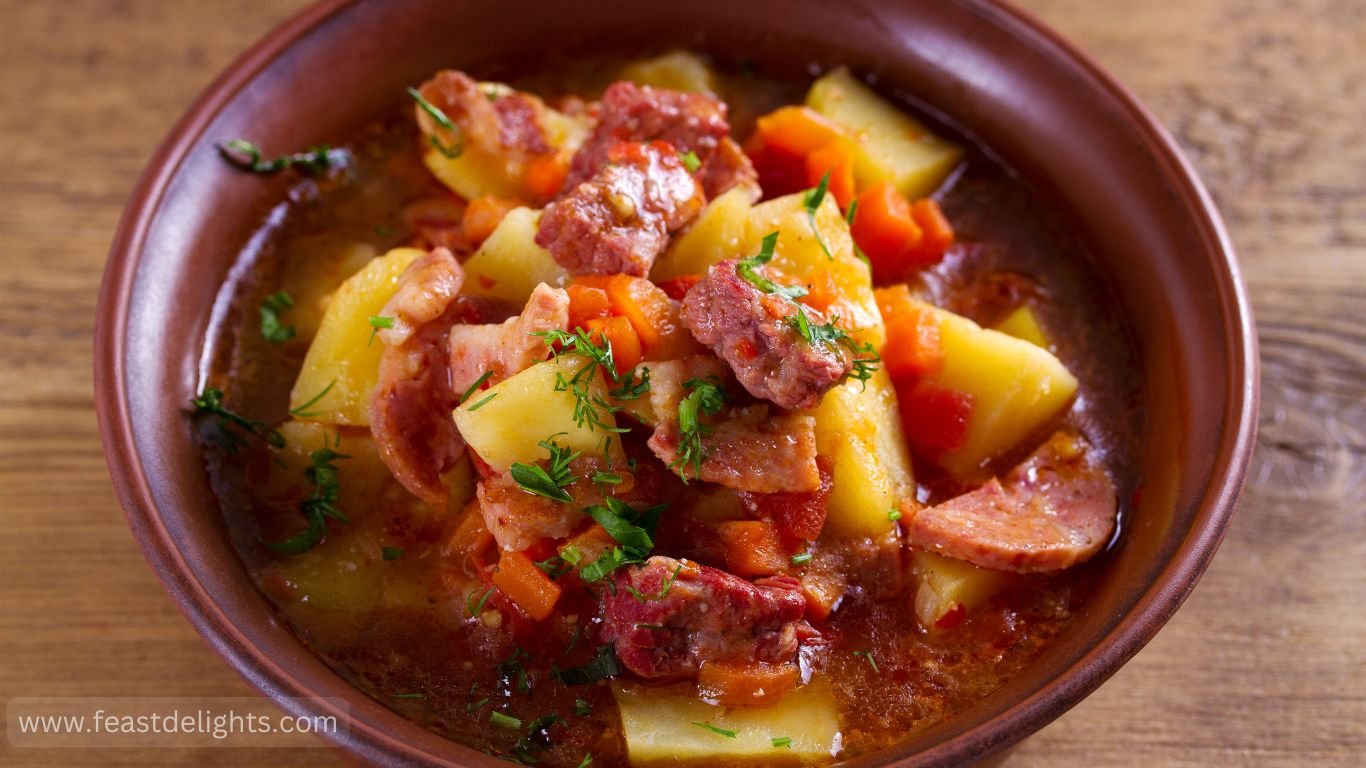
Recipe card
Hungarian Bogrács-Style Beef and Pork Stew
About 2½ hours cooking; allow longer if the meat is not nearly tender after the first 90-minute simmer. Potatoes need a further 25–30 minutes.
Equipment: Heavy 5–6 litre lidded pot, kitchen scale, measuring jug, knife, separate raw-meat chopping board, spoon, fork and food thermometer.
Ingredients
Meat
Cooking fat
Vegetables and seasoning
Broth and finish
Instructions
Prepare the meat and vegetables
Cut the beef chuck and pork shoulder into roughly 2.5–3 cm cubes. Keep raw meat separate from the prepared vegetables. Dice the onions and peppers, slice the carrots, mince the garlic and chop the tomatoes. Leave the potatoes uncut until the meat is nearly tender.
Brown in batches
Heat the oil in a heavy 5–6 litre pot over medium-high heat. Pat the meat dry, brown in small batches for about 10–15 minutes overall and transfer to a plate. Do not crowd the pan or cook the meat through at this stage.
Soften the vegetables
Reduce to medium heat. Add the onions and carrots and cook for about 5–7 minutes, stirring and loosening the browned bits. Add the peppers and garlic and cook for 2 minutes more. If the base is catching, add a small splash from the measured water or stock.
Add paprika without scorching
Take the pot briefly off the heat. Stir in the sweet paprika and caraway, then add the tomatoes, optional wine and any meat juices. Return the beef and pork to the pot. If omitting wine, use 100 ml additional water or stock instead.
Simmer gently
Add the 1 litre water or stock and bay leaves, and bring to a simmer. Cover and lower the heat so the surface bubbles gently. Simmer for about 90 minutes, stirring occasionally. Check the meat: if it is still firm, continue in 15-minute intervals before adding the potatoes. Add hot water if the liquid drops too low.
Cook the potatoes
Peel and cube the potatoes into roughly 2.5 cm pieces. Add them when the meat is nearly tender, then simmer for 25–30 minutes until a fork enters the potatoes easily and both meats are tender. Cook a little longer if necessary; the clock is only a guide.
Adjust and serve
Remove both bay leaves. Taste the broth and adjust salt and pepper, especially if using salted stock. If too thin, simmer briefly with the lid off; if too thick, add hot water. Stir in or scatter over the parsley and serve hot.
Doneness and troubleshooting
The stew is ready when a fork slips easily into the meat and the potatoes are tender all the way through. A bubbling pot can be hot enough for safety long before collagen-rich meat is pleasant to eat, so tenderness is the practical finish cue. If the meat is chewy, keep simmering gently and delay the potatoes. Hard boiling evaporates liquid quickly and can leave the meat less pleasant in texture.
If the broth is watery once everything is tender, remove the lid and simmer briefly. If it is thick or salty, add a little hot water before judging the seasoning again. Do not repeatedly scrape a badly burned base into the food. Stir gently once the potatoes are cooked to avoid breaking them apart.
Success tips
- Pat the meat dry and brown in small batches to build flavour.
- Use a gentle simmer rather than a rolling boil for the long cooking stage.
- Add paprika away from direct heat and follow it promptly with tomatoes and liquid.
- Judge the meat before adding potatoes; different cuts soften at different rates.
Variations and serving
For heat, add a small amount of hot paprika while keeping sweet paprika as the base. Smoked paprika gives a different flavour, so use a little rather than replacing all the sweet paprika. Omit the wine and use stock or water for an alcohol-free version. Choose stock carefully: wheat, celery or other allergens can occur in prepared products. The base recipe does not need dairy, but an optional spoonful of sour cream adds milk.
Serve with crusty bread, pickled vegetables, a spoonful of sour cream or extra parsley. For an all-beef direction, see Hungarian-inspired beef stew with potatoes. For a version containing beans and sausage, see Transcarpathian bograch. These are separate formulas rather than additions to make without adjusting this pot.
Make ahead, storage and reheating
Divide leftovers into shallow containers and refrigerate within 2 hours, or within 1 hour above 32°C (90°F). Keep at 4°C (40°F) or below and use within 3 days. Freeze portions for up to 3 months for best quality; potatoes may soften. Thaw in the refrigerator. Reheat the stew, stirring, to 74°C (165°F) throughout; bring the broth to a rolling boil.
Do not leave a full deep pot at room temperature until completely cold. Portion it into shallow containers so it can cool quickly in the refrigerator. Freeze in meal-sized portions to avoid reheating the whole batch repeatedly. Add a little water during reheating if the potatoes have thickened the broth.
Serve when the meat yields easily to a fork and the potatoes are tender, with bread ready to catch the paprika broth.
Frequently asked questions
Is this the same as outdoor bogrács?
It uses a heavy stovetop pot and keeps the paprika-led character, but it does not reproduce cooking over a wood fire. Regional kettle stews vary, so this is labelled as an adaptation.
Can I leave out the pork?
Replace the 400 g pork shoulder with another 400 g beef chuck. The flavour changes and the simmer may take longer; add the potatoes only once the beef is nearly tender.
What if the paprika tastes bitter?
It may have scorched when added to a hot, dry pan. Adding more sugar does not remove burned flavour. Briefly remove the pot from the heat before stirring paprika in, then add the wet ingredients promptly.
Do I have to use wine?
No. Use 100 ml water or stock in its place. Cooking with wine does not guarantee that every trace of alcohol disappears, so omit it for an alcohol-free version.
Can I cook the potatoes from the beginning?
They are likely to break down before the meat becomes tender. Add them late unless you deliberately want a much thicker, softer stew.
Can I make it the day before?
Yes. Cool in shallow portions and refrigerate promptly, then reheat thoroughly. The potatoes may absorb broth, so add a little water while reheating.
More recipes to try






Spotted a detail that needs correcting? Contact the FeastDelights editors.