Honey Walnut Baklava with Cinnamon and Lemon Zest
Honey walnut baklava is a layered dessert of crisp buttered phyllo, finely chopped walnuts and cinnamon, finished with honey syrup scented with lemon zest. This version uses a 23 × 33 cm pan and makes about 24 diamonds or squares. Prepare the syrup early so it can cool while you assemble and bake the pastry. Allow about 35 minutes for assembly, 40 minutes for baking and several hours for the syrup to absorb. Serve in small pieces with unsweetened tea or coffee.
Honey walnut baklava layers thin phyllo pastry with cinnamon-scented walnuts and melted butter. The baked layers are soaked with a honey and lemon-zest syrup, leaving a crisp top and a sweet, nutty centre. This version uses walnuts only, rather than mixed nuts or pistachios, and makes 24 pieces in a 23 × 33 cm (9 × 13 inch) pan. Allow 35 minutes for preparation, about 40 minutes baking and at least four hours for absorption.
Choosing the phyllo and walnut filling
Baklava has many regional forms, with different nut fillings and syrups. This is the retained walnut, cinnamon and honey version, not a claim to a single traditional formula. Use thin phyllo sheets, thawed according to the packet. A 500 g package may contain a different number of sheets depending on the manufacturer. The original method calls for 24 sheets, divided into four stacks of six. If the count differs, divide them as evenly as possible; reserve a substantial top and bottom layer.
Chop the walnuts finely enough to spread in an even layer but not so finely that they turn oily. Cinnamon brings warmth to the filling. Melt the butter and brush lightly; puddles between layers can produce a greasy finish. Keep the unused sheets covered with a barely damp towel on the work surface, not near the heating elements. A towel that is too wet can make the pastry sticky.
Plan the syrup before baking
Start the syrup early. Dissolve sugar in the measured water and honey, simmer gently for eight to ten minutes, and add lemon zest off the heat. The original recipe uses zest rather than lemon juice, so the syrup is fragrant but not very acidic. Avoid reducing it to a thick candy. Let it cool while the pastry bakes. The retained honey and sugar proportions produce a sweet dessert and still need a practical trial to confirm the absorption.
Layer and cut the pastry
Brush the pan and lay down the first group of sheets, brushing each one with a light coat of butter. Scatter a third of the walnuts evenly, including the corners. Repeat twice and finish with the last stack. A torn sheet can be patched without discarding the entire layer. Cut through to the base with a sharp knife before baking. Aim for 24 portions; squares are easier to divide evenly than diamonds if you are new to the method.
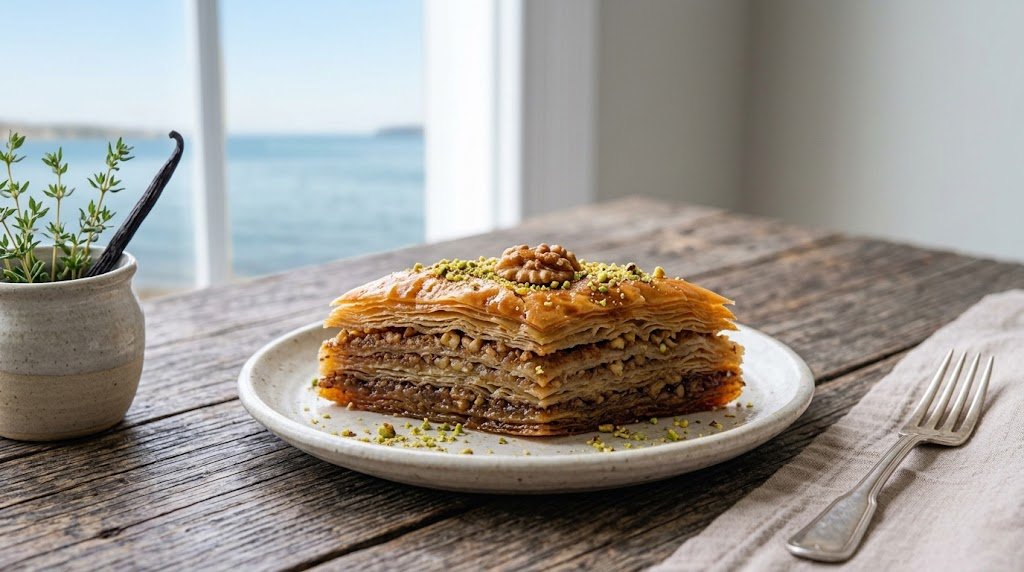
Recipe card
Honey Walnut Baklava with Cinnamon and Lemon Zest
Syrup preparation overlaps with assembly and baking. Includes four hours of absorption; phyllo thawing time is extra.
Equipment: 23 × 33 cm baking pan, pastry brush, knife, saucepan, measuring jug, clean barely damp towel, heatproof rack
Ingredients
Pastry and filling
Syrup
Instructions
Prepare the pastry and cooled syrup
Preheat oven to 180°C (350°F). Butter a 23 × 33 cm pan. Combine chopped walnuts and cinnamon. Keep thawed phyllo under a clean barely damp towel away from the oven. Simmer honey, sugar and water for 8–10 minutes, stir in zest off heat and set aside to cool.
Build the layers
Brush each phyllo sheet lightly with butter. Aim for four stacks of six sheets, with one-third of the walnuts between each stack. If the package has a different sheet count, divide the sheets into four reasonably even stacks. Trim to fit the pan.
Cut and bake
Use a sharp knife to cut through the pastry into 24 diamonds or squares before baking. Bake about 35–40 minutes until deeply golden and the top layers are crisp, checking the edges for premature browning.
Check and finish the syrup
While baking, check the syrup has cooled to room temperature. It should pour easily rather than set into a thick candy. Do not boil it again unless needed to dissolve undissolved sugar; cool before using.
Soak and rest
Pour cooled syrup slowly over the hot pastry, especially along cut lines. Let it absorb uncovered for about four hours on a clean rack or heatproof surface. Once cool, cover loosely or transfer to a covered container and refrigerate for longer storage.
Judge the bake and absorb the syrup
The top should be deeply golden, not pale, and the edges crisp. Ovens vary, so check near the lower end of the baking range. Remove the hot pan carefully and pour the cooled syrup gradually along the cuts and edges. Do not rush to separate the pieces while hot; the syrup needs several hours to move through the layers. If syrup pools, pause briefly to allow it to soak before adding the remainder.
Serving, make ahead and allergens
Serve in small pieces with tea or coffee. Make the pastry ahead to allow the full absorption period. This recipe contains wheat, milk and walnuts; check phyllo packaging for other allergens. Honey is unsuitable for infants under 12 months. The original pan size, sheet count and syrup ratio need kitchen confirmation.
Compare other baklava variations
For a different nut combination see filo baklava with mixed nuts or pistachio baklava with cardamom syrup. For another syrup-soaked dessert, try basbousa semolina cake.
Frequently asked questions
Can I use filo instead of phyllo?
Yes, the spellings describe the same type of thin pastry.
Why did the sheets tear?
Phyllo dries quickly. Keep unused sheets covered and avoid soaking them with a wet towel; patch small tears with another piece.
Do I need exactly 24 sheets?
The original layering uses four groups of six. Package sizes differ, so divide the available sheets evenly and keep the top and base well layered.
Why cut before baking?
Unbaked sheets are easier to cut cleanly. Cutting after baking can crush and scatter the crisp layers.
Should the syrup be hot?
This method uses cooled syrup over hot pastry. Pour slowly along the cuts so it distributes evenly.
Why is my baklava soggy?
Underbaked pastry, heavy buttering or too much syrup pooled in one area can soften layers. Bake until golden and distribute syrup gradually.
Can I make it ahead?
Yes. Allow the syrup to absorb before serving; keep cooled pieces covered and refrigerated for the conservative storage period listed.
Can infants eat baklava?
Do not give honey-containing foods to babies under 12 months. This recipe also contains walnuts, wheat and milk.
More recipes to try






Spotted a detail that needs correcting? Contact the FeastDelights editors.