Refrigerator Plum Jam Recipe with a Cold-Plate Test
Ripe plums cook down with sugar into a glossy, deep-coloured jam with a soft, spreadable set. Resting the cut fruit with sugar draws out juice before heating, and a chilled plate helps you judge when the mixture has thickened enough. This batch makes roughly four US cups, although plum variety and evaporation affect the yield. Plan for about one hour and fifty minutes before cooling and refrigeration. Enjoy on toast or in cakes, and freeze extra portions rather than storing them in the pantry.
Refrigerator plum jam is a sweet-tart fruit spread made with ripe plums, sugar and optional food-grade citric acid. It uses no added commercial pectin and makes about four US cups, depending on reduction. Allow 20 minutes to prepare, 30–40 minutes for the fruit to release its juices, and up to 50 minutes to cook and test the set. Chill promptly after cooking; this is not a shelf-stable canning recipe.
Choosing plums and sugar
Weigh one kilogram (2.2 lb) of plums after removing stones. Use sound ripe fruit, with some slightly underripe plums if available for their natural pectin. The 800 g sugar contributes sweetness and helps the gel form. Do not assume that less sugar gives the same result. A quarter teaspoon of food-grade citric acid is optional; it changes acidity and flavour, but does not establish shelf stability. The National Center for Home Food Preservation explains how fruit, acid, sugar and pectin work together to create a gel.
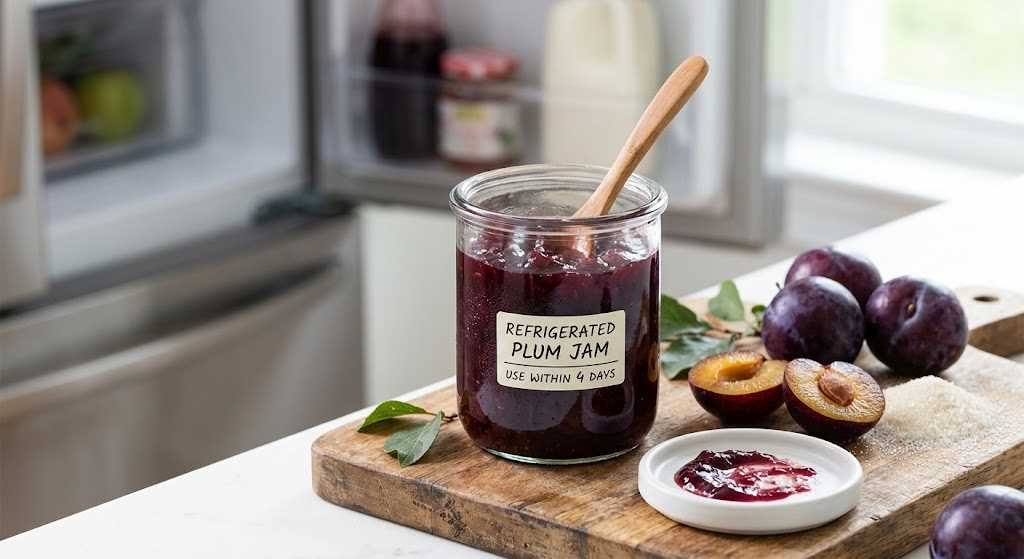
Recipe card
Refrigerator Plum Jam Recipe with a Cold-Plate Test
Includes up to 40 minutes of refrigerated maceration and up to 50 minutes for heating, simmering and testing. Cool promptly afterwards; the set firms further when cold.
Equipment: Kitchen scales, knife, cutting board, 4–5 litre heavy non-reactive saucepan, long-handled spoon, two chilled plates, ladle, shallow heat-safe containers
Ingredients
Plum jam
Instructions
Prepare and weigh the plums
Wash the plums, halve and remove stones, then weigh 1 kg of prepared fruit. Cut large halves into quarters. Chill two small plates in the freezer for testing.
Macerate with sugar
Combine plums and sugar in a heavy non-reactive saucepan, cover and refrigerate for 30–40 minutes until juice begins to collect. Stir once or twice.
40 minCook and reduce
Bring the mixture slowly to a boil over medium heat, stirring until sugar dissolves. Reduce to a steady simmer and cook for 20–30 minutes, stirring frequently and then almost constantly as it thickens. Allow additional cooking if the fruit is watery. Avoid splashes of hot sugar.
40 minCheck the cold-plate set
Stir in the optional food-grade citric acid near the end. Take the pan off the heat, place a little jam on a chilled plate and let it cool briefly. Push the cooled sample; if it wrinkles slightly or forms a soft gel, the jam is ready. If it remains runny, return to a simmer and test again after a few minutes.
10 minCool and refrigerate or freeze
Ladle into clean shallow heat-resistant containers. Cool promptly and refrigerate within two hours (one hour above 32°C/90°F). Use within three days or freeze extra portions. Never store these jars at room temperature.
Why macerate the fruit first?
Rest the plums with sugar in the refrigerator for 30–40 minutes. Sugar draws out juice, creating liquid around the pieces and helping the sugar dissolve as heating starts. Use a wide, heavy pan with enough room for the mixture to foam. Bring to a boil gradually, then keep the fruit bubbling steadily while stirring the base of the pan. Thick jam can burn quickly, so stir more frequently as it reduces.
Using a cold plate to test the set
Chill a small plate before cooking. Take the pan off the heat during the test so the mixture does not continue reducing. Place a teaspoon of jam on the cold plate, wait briefly and push it gently. A slight wrinkle or soft gel suggests it is ready. This checks texture, not preservation safety. If it runs like juice, cook a few minutes longer and test again. Stop before the jam becomes too thick; it firms further on cooling. The NCHFP’s jam guidance also describes a chilled-plate test.
Texture, serving and variations
Leave the softened fruit pieces for a rustic spread. If the jam becomes stiff, serve a small portion with a little warm water stirred in just before use; do not dilute stored jam. Try it with thin crisp waffles, fruit jam sponge roll or jam-filled crescent cookies. Check accompanying baked goods for wheat, eggs, milk or nuts.
Refrigerator and freezer storage
Transfer to clean, shallow heat-safe containers and refrigerate at 4°C (40°F) or colder within two hours of cooking, or within one hour above 32°C (90°F). Use within three days as a conservative limit for this formula. Freeze extra portions promptly in freezer-safe containers, leaving expansion space, for up to three months for best quality. Thaw in the refrigerator and use within three days. Discard the entire container if mould appears; do not scrape it off. Do not pantry-store or can this recipe. For shelf-stable plum jam, use the separately tested NCHFP plum jam recipe and its full processing directions. The ingredient proportions on this page are different.
Check the set once the jam is cool, then spoon it onto toast or use as a filling. Keep only a small container in the refrigerator and freeze the remaining portions.
Frequently asked questions
Can I use very ripe plums?
Yes, although very ripe fruit often contains less pectin and can give a softer set. A mixture of ripe and slightly underripe sound fruit may set more readily.
Do I need added pectin?
No commercial pectin is specified. The set depends on natural pectin, acidity, sugar and reduction; a softer spread is acceptable.
Why did the jam remain runny?
Fruit may contain more water or less pectin. Let the jam cool before judging, and use the cold-plate test during cooking rather than relying only on the clock.
Can I reduce the sugar?
This formula depends on the specified sugar for texture. Use a separate reduced-sugar jam recipe rather than assuming the same set or storage behaviour.
Can I store unopened jars in the pantry?
No. The formula is for refrigeration or freezing only. A tested canning recipe and its exact process are required for pantry storage.
Can I freeze this jam?
Yes. Use freezer-safe containers with expansion space, cool and freeze promptly, then thaw in the refrigerator.
More recipes to try

Cream Cheese Chocolate Truffles Rolled in Cocoa

Cream Cheese Cheesecake Danish with Lemon and Vanilla

Fresh Fruit Salad with Orange Honey Dressing

Ptichye Moloko Bird’s Milk Mousse with Chocolate Glaze
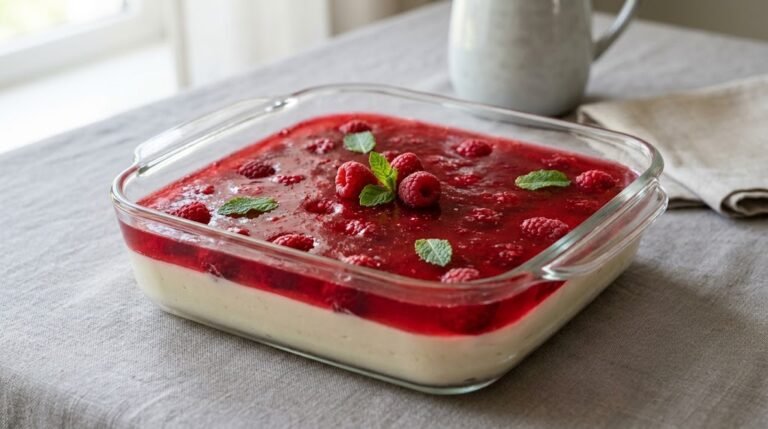
Bird’s Milk Jello with Creamy Mousse and Raspberry Jelly
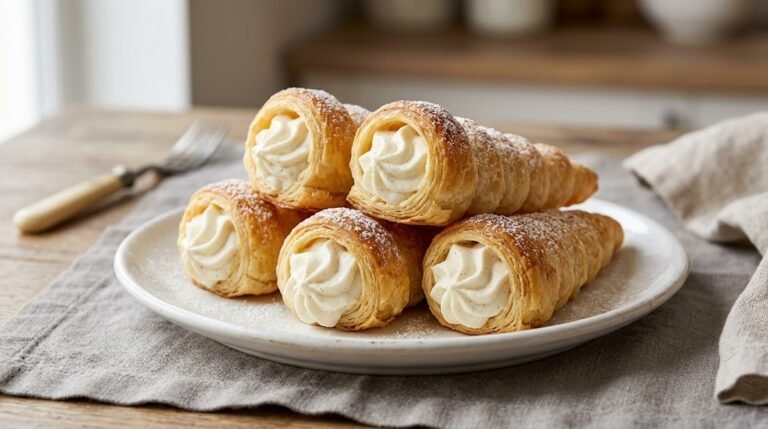
Cream Horn Trubochki with Vanilla Cream Filling
Spotted a detail that needs correcting? Contact the FeastDelights editors.