Simplified Saint-Honoré with Vanilla Cream and Berries
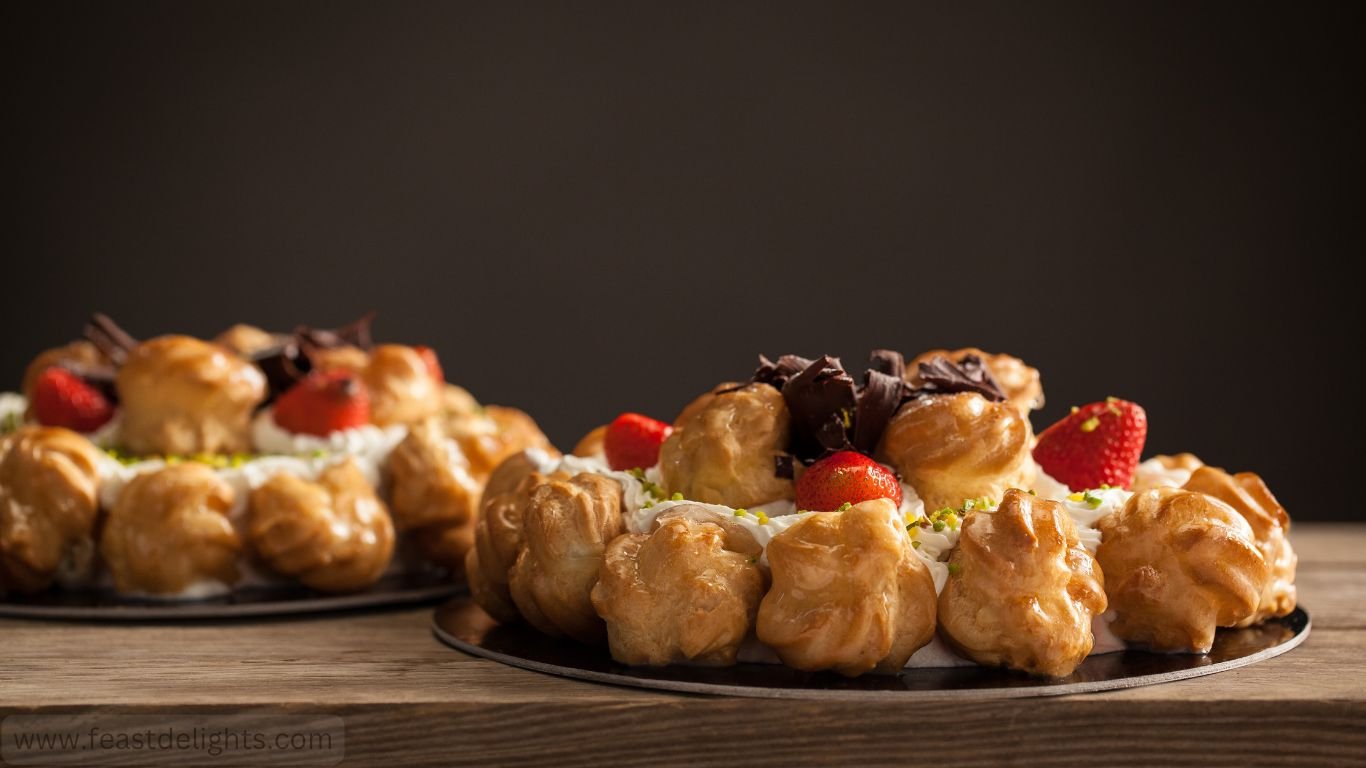
This simplified Gâteau Saint-Honoré combines a crisp puff pastry disc with a homemade choux ring, small choux puffs, chilled vanilla pastry cream and lightly sweetened whipped cream. Fresh berries add colour and tartness. Unlike the classic caramel-coated French pastry, this home adaptation uses cream to hold the components together. Bake the pastry pieces separately and cool them completely before assembling. The dessert serves eight and benefits from preparing the pastry cream well in advance.
This simplified Saint-Honoré is a French-inspired dessert with a crisp puff pastry disc, a ring of choux pastry, vanilla pastry cream, whipped cream and fresh berries. It makes eight servings and requires planning: the pastry cream needs at least four hours to chill, while the base and choux must be fully baked and cool before assembly. Allow up to six hours and forty minutes if working through the stages without much overlap.
How this version differs from classic Saint-Honoré
Classic Gâteau Saint-Honoré combines puff pastry, choux puffs, cream and usually caramel. Le Cordon Bleu’s description identifies a pastry base with a border of caramel-coated choux and Chantilly cream. The version here deliberately avoids the caramel stage and uses a separate baked choux ring, small puffs and berries. It retains the combination of crisp pastry and cream without claiming to reproduce a traditional chiboust-filled cake.
Planning the ingredients and stages
Use a sheet of all-butter puff pastry large enough to cut a 22 cm circle. Keep it cold so its layers remain distinct. The choux uses equal amounts of water and milk, butter, flour and up to four whole eggs. The pastry cream uses a separate 500 ml milk, four yolks, sugar, starch, butter and vanilla. Do not confuse these quantities. Finally, cold heavy cream and icing sugar make the topping. Choose berries that are firm enough to hold their shape and dry them after washing.
Start with the pastry cream because it has the longest waiting time. While it chills, bake the base and make the choux. The cooled pastries can be stored separately if working ahead. Keep the custard and whipped cream refrigerated, then assemble shortly before serving. This sequence makes the dessert manageable without trying to finish every component at once.
Making vanilla pastry cream
Heat the milk until steaming, not boiling hard. Whisk yolks with sugar and cornstarch and gradually add some hot milk. This tempering step gently raises the egg temperature before returning the mixture to the pan. Whisk continuously as it thickens, making sure the utensil reaches the corners. Let bubbles appear across the surface, then cook briefly while whisking. Stir in butter and vanilla off the heat. Refer to our vanilla pastry cream recipe for another version of this technique.
Transfer the cream to a shallow clean container, cover its surface and refrigerate promptly. The King Arthur Baking pastry cream method also uses a covered, thorough refrigerator chill. The custard should become thick enough to hold its shape when spooned or piped. If it is still warm, do not assemble the dessert yet.
Baking the puff pastry base
Cut a clean circle using a plate or template. Prick the centre with a fork to discourage excessive puffing. Bake on a lined tray until the pastry is golden through rather than pale at the base. If the centre rises too much, gently flatten it after baking while still warm. Cool on a rack so steam can escape underneath.
Making and piping choux pastry
Heat water, milk, butter, sugar and salt together. Add the flour all at once when the liquid boils and stir until the paste gathers into a ball. A light film on the pan base is a useful cue that some moisture has evaporated. Let the paste cool briefly before adding egg so the egg does not cook on contact. Add beaten egg in stages. The dough may look separated temporarily, but should become smooth as each addition is incorporated.
Check consistency before adding the final portion of egg. Lift the spatula: the paste should fall in a thick V-shaped ribbon and still hold its shape when piped. Too much egg can make the ring spread into a flat layer. For more detail, see our choux pastry for éclairs and King Arthur Baking’s choux guide.
Pipe the ring separately on parchment rather than placing raw choux on an already-baked puff pastry disc. This editorial adjustment avoids a prolonged second bake for the base. Mark a circle slightly smaller than the disc to allow for expansion. Pipe small mounds from the remaining paste, keeping their sizes consistent. The ring may take longer to dry than the puffs. If needed, bake separately to avoid opening the oven before either batch has set.
Recipe card
Simplified Saint-Honoré with Vanilla Cream and Berries
Allow up to 85 minutes for stovetop custard, puff pastry disc, choux paste and baking. Chill pastry cream for at least 4 hours; cool pastry pieces during this period where possible. Baking in separate batches may add time.
Equipment: Kitchen scale, two heavy saucepans, whisk, heatproof spatula, fine sieve, shallow cooling container, food-safe heat-resistant film, 22 cm circle template, parchment, two or three flat baking trays, mixing bowls, mixer, piping bags and 1–1.5 cm round tip, rack and thermometer.
Ingredients
Puff pastry base
Choux pastry
Vanilla pastry cream
Whipped cream and fruit
Instructions
Cook and chill the vanilla pastry cream
Heat the 500 ml milk until steaming. Whisk four egg yolks, 100 g sugar and 35 g cornstarch until smooth. Gradually whisk in about one-third of the hot milk, then return to the saucepan. Cook over medium heat, whisking continuously, until bubbles appear across the surface. Keep at a gentle boil for about one minute while whisking; the custard must reach at least 71°C (160°F). Remove from heat, stir in vanilla and 30 g butter, strain if needed and spread in a shallow container. Cover the surface and refrigerate promptly at 4°C (40°F) or below for at least 4 hours.
Bake the puff pastry disc
Preheat conventional oven to 200°C (400°F). Cut a 22 cm circle from cold thawed puff pastry and place on parchment on a tray. Prick the centre evenly with a fork. Bake 15–20 minutes until golden and cooked through; extend as needed. If the centre balloons, gently flatten it with a clean flat utensil after baking. Cool completely on a rack.
Prepare the choux paste
Bring 125 ml water, 125 ml milk, 100 g butter, the tablespoon of sugar and salt to a boil in a saucepan. Add flour all at once and stir firmly over medium heat until a smooth ball forms and a thin film appears on the pan base, about 1–2 minutes. Transfer to a bowl and cool 5 minutes. Beat the four eggs separately, then add a little at a time, mixing well until the paste is glossy and falls from the spatula in a thick V-shaped ribbon. Stop adding egg once it is pipeable and holds its shape; you may not need every drop.
Pipe and bake the ring and puffs
Trace a 20 cm circle on parchment, flip it so the marks face down, and pipe a continuous ring about 2–3 cm thick along the guide. On a separate lined tray, pipe evenly sized 3 cm mounds from the remaining paste. Allow room for expansion. Bake at 200°C (400°F) for 10 minutes, then reduce to 180°C (350°F) for 20–25 minutes or longer, without opening the oven early. Bake the ring and puffs in separate batches if necessary; a larger ring may need longer than small puffs. Check that shells are deeply golden and dry inside, pierce a small vent in each puff and cool fully.
Assemble with chilled creams
Place the cooled puff pastry disc on a serving plate. Stir the cold pastry cream briefly until smooth and spread a small amount around the edge to anchor the choux ring. Set the ring on the base and fill the centre with the remaining pastry cream, reserving some to fill a few puffs if desired. Whip the cold 250 ml cream with 25 g icing sugar to medium peaks. Pipe or spoon it over the custard, then arrange the small choux puffs and washed, thoroughly dried berries on top. Serve surplus puffs separately.
Chill and serve
Keep the assembled dessert refrigerated until serving. Assemble close to serving time for crisp pastry, cut into eight portions with a serrated knife and serve cold. Refrigerate leftovers promptly.
How to check that choux is baked through
The pastry should be deeply golden, light and firm. Colour alone is not enough: open a spare puff after the initial baking period and check whether the interior is dry. If the inside remains gummy, continue baking for a few minutes. Pierce a small opening in cooked puffs so steam can escape, then cool completely. A collapsed ring can still be served as individual puffs with the creams rather than discarded.
Assembling the dessert
Set the cooled pastry base on a flat plate. Use a little thick chilled pastry cream as an adhesive for the ring. Spoon the remaining cream into the centre, reserving some for individual puffs if desired. Whip the cold cream and icing sugar until the whisk leaves defined but slightly bending peaks. Arrange the whipped cream, berries and small puffs without piling them so high that the base becomes unstable. Use surplus puffs on a separate plate.
Troubleshooting
Runny choux: The paste may contain too much egg or may not have dried sufficiently on the stove. Add egg gradually and use the V-shaped ribbon cue. Do not stir raw flour into the finished paste as an untested fix.
Deflated puffs: Bake longer before opening the oven. Dry the interior and vent the steam once baked.
Custard lumps: Temper slowly, whisk constantly and strain small lumps while warm.
Soggy base: Bake the disc fully, cool the components and delay assembly. Wet fruit and warm cream soften the pastry rapidly.
Whipped cream loses its shape: Use cold full-fat cream and stop at medium peaks. Refrigerate immediately after assembly.
Serving and related recipes
Serve chilled in small slices. If you prefer separate portions, our vanilla whipped cream puffs use similar choux shells. For a layered puff pastry dessert, see mille-feuille with pastry cream. A few fresh berries provide enough tartness without adding a wet sauce to the base.
Make ahead, storage and allergens
Prepare pastry cream a day ahead and chill promptly; the egg mixture must be fully cooked. Store dry baked components separately and assemble near serving time. Refrigerate the filled dessert and consume it the same day for best texture. The recipe contains wheat, milk and eggs. Follow FoodSafety.gov refrigeration guidance and check the pastry packaging for other allergens. The exact ring expansion and amount of spare choux need a kitchen test with the selected pan and piping tip.
Frequently asked questions
Is this classic Gâteau Saint-Honoré?
It is a simplified adaptation. Classic versions commonly use caramel-coated choux puffs and cream; this version omits caramel and uses vanilla pastry cream, whipped cream and berries.
Why bake the choux ring separately?
The original method risks baking an already-cooked puff pastry base twice. Baking the ring on its own helps control the two components and allows them to be assembled with cream.
Why add the eggs gradually to choux?
The amount needed varies with flour, egg size and moisture lost during cooking. Stop when the paste is glossy and forms a thick V from the spatula rather than pouring.
Why do choux puffs collapse?
The structure may not have set fully. Avoid opening the oven early, bake until the interior is dry and release trapped steam before cooling.
Can I make the pastry cream the day before?
Yes. Cool promptly, refrigerate covered at 4°C or below, and use within two days.
Can I use a prepared pastry cream?
Yes, use a thick, chilled pastry cream suitable for piping; check its ingredients and storage instructions.
How do I keep the base crisp?
Bake it fully, cool all components, pat berries dry and assemble shortly before serving.
Can I freeze the dessert?
Freeze unfilled pastry pieces if needed. The assembled custard and whipped cream dessert is not suitable for freezing because the filling may separate.
Do I need a piping bag?
It is strongly recommended for an even choux ring. A spoon can portion small puffs, but the ring is harder to shape consistently.
More recipes to try






Spotted a detail that needs correcting? Contact the FeastDelights editors.