Vanilla Sour Cream Loaf Cake
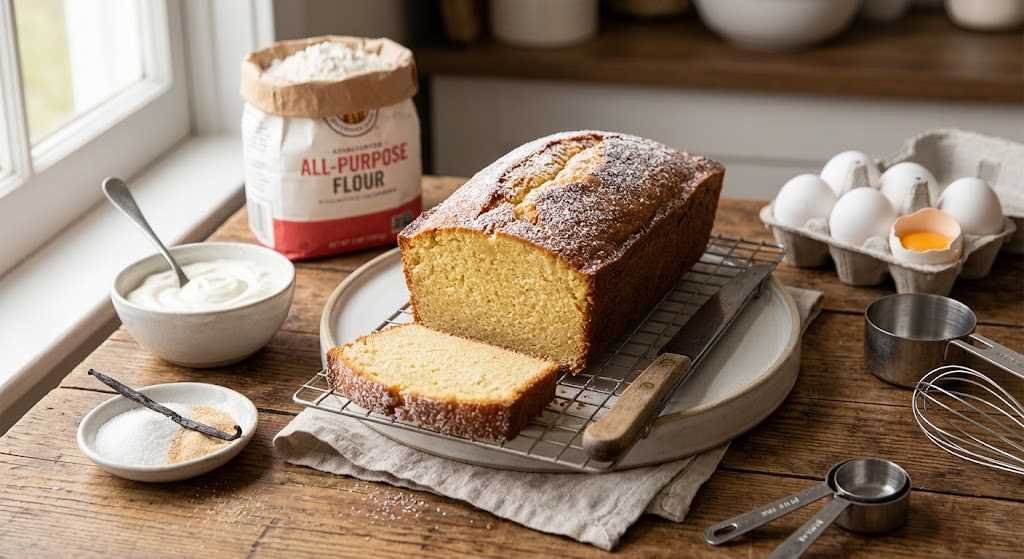
This vanilla sour cream loaf cake uses whipped eggs and sugar for lift, with sour cream providing moisture and a gentle tang. There is no butter in the batter: the small quantity of neutral oil is used only to grease the tin. The cake has a pale, tender crumb and a golden top, and makes ten slices. Allow around 75 minutes through initial cooling, plus further cooling before slicing. Serve plain with tea, coffee or fresh fruit.
Unlike a classic butter pound cake, this loaf relies on beaten eggs, sour cream and baking powder. Keeping air in the egg mixture and folding in the flour gently helps prevent a dense, rubbery crumb.
Vanilla sour cream loaf cake at a glance
Expect ten slices from a 23 × 13 cm (9 × 5 inch) loaf tin. Allow 20 minutes for preparation, 40–45 minutes for baking, 10 minutes cooling in the tin and additional rack cooling. The original formula contains no butter in the batter, so this is described as a sour cream loaf rather than a traditional pound cake.
Ingredients and equipment
Weigh 300 g plain flour (about 2½ US cups at 120 g per cup), 200 g granulated sugar (about 1 cup) and 200 g sour cream (about ¾ cup plus 1 tablespoon, depending on density). Full-fat sour cream gives a richer crumb than reduced-fat versions. Use three large eggs, 1½ teaspoons baking powder, 8 g vanilla sugar or 1 teaspoon vanilla extract, a pinch of fine salt and 1 tablespoon neutral oil for greasing only.
A scale is especially useful for the flour: scooping can add enough extra flour to toughen the loaf. Use a mixer, whisk, flexible spatula, baking paper, skewer and cooling rack. Line the long sides and base of the tin with paper, leaving an overhang to lift the cake. Grease exposed surfaces with the measured oil.
Recipe card
Vanilla Sour Cream Loaf Cake
20 minutes preparation + up to 45 minutes baking + 10 minutes in the tin = 75 minutes; further rack cooling is additional. Pan size and baking time need kitchen confirmation.
Equipment: 23 × 13 cm (9 × 5 inch) loaf tin, baking paper, scale, mixer, whisk, spatula, skewer and cooling rack.
Ingredients
Cake batter
Pan or finish
Instructions
Prepare pan
Preheat conventional oven to 180°C (350°F). Grease a 23 × 13 cm loaf tin with the measured oil and line with baking paper.
Whip eggs and sugar
Beat eggs, sugar, vanilla and salt 4–5 minutes until pale, thick and airy.
Add sour cream
Gently fold in the sour cream until evenly mixed.
Add dry ingredients
Whisk flour and baking powder, then fold into the egg mixture in two additions. Stop when no dry streaks remain.
Bake
Transfer to the tin and bake 40–45 minutes or until a skewer in the centre comes out without wet batter. Cool 10 minutes in the tin, lift onto a rack and cool fully.
Whipping and folding the batter
Beat eggs, sugar, vanilla and salt for 4–5 minutes until pale, thicker and foamy. A ribbon of mixture should briefly remain on the surface. Fold in the sour cream gently, scraping the bottom so it is evenly dispersed. Whisk flour and baking powder separately, then fold them into the wet mixture in two additions. Stop as soon as dry streaks disappear. Avoid vigorous beating once flour is present.
How to judge the bake
Preheat a conventional oven to 180°C (350°F) and bake on the middle shelf. Begin checking at 40 minutes. A skewer inserted into the deepest centre should emerge without wet batter; the surface should spring back gently. If the top colours before the centre sets, loosely cover with foil and continue baking. Ovens and tin materials vary, so the estimated 45 minutes is not a deadline. Cool in the tin for 10 minutes, lift onto a rack and allow the cake to cool completely.
Troubleshooting
Dense crumb: the eggs may not have been whipped enough or the batter overmixed. Dry loaf: weigh the flour and check early. Sunken centre: make sure the centre is set before removing from the oven; avoid opening the door early. Sticking: line the tin and allow the first cooling period before lifting.
Variations and serving
Finely grated lemon or orange zest can complement vanilla without adding much liquid. Use the stated vanilla extract alternative rather than changing the sugar content arbitrarily. Do not replace the full amount of sour cream with milk: the batter would become thinner. Serve with berries or a little jam. For fruit in the batter try the distinct raisin and sour cream cake, which uses creamed butter; for a spiced sheet cake see honey and kefir kovrizhka.
Make ahead, storage and allergens
Bake the day before if desired, but do not mix the batter far in advance because its leavening begins once moistened. Contains wheat, eggs and milk. Check vanilla sugar and baking powder labels when allergens are a concern.
Cool completely, wrap and refrigerate for up to 3 days. Freeze wrapped slices for up to 2 months for best quality; thaw covered in the refrigerator.
Let the loaf cool fully before slicing so the crumb sets neatly. Serve plain or with berries on the side.
Frequently asked questions
Is this a traditional pound cake?
No. The original batter uses sour cream and whipped eggs rather than butter, so it is more accurately a vanilla sour cream loaf cake.
Can I use vanilla extract instead of vanilla sugar?
Yes, the original recipe allows one teaspoon of vanilla extract in place of 8 g vanilla sugar.
Can I use a tube tin?
A suitably sized tube tin may work but bakes differently; the timing here is for a loaf tin and needs checking.
Why is my cake rubbery?
Mixing too vigorously after adding flour can develop gluten and deflate the egg foam.
Can I freeze individual slices?
Yes. Cool completely, wrap separately and freeze for up to two months for quality.
More recipes to try






Spotted a detail that needs correcting? Contact the FeastDelights editors.