Ukrainian Kefir Verguny Fried Pastry Twists
Ukrainian kefir verguny are lightly sweet fried pastry twists made with kefir, eggs, flour and baking soda. The dough is rolled into strips, threaded through a slit and fried until golden, with a soft interior and lightly crisp edges. A dusting of icing sugar finishes the pastries. This recipe makes about 20 pieces in roughly 60 minutes, including a 15-minute dough rest and frying in small batches. Serve them slightly warm with tea, coffee or fruit preserves.
Verguny are Ukrainian fried dough pastries shaped into twists. This kefir version uses baking soda rather than yeast, giving a softer, puffier result than very thin, crisp fried pastry ribbons. Even thickness and controlled oil heat help the centres cook before the outside darkens. Allow 25 minutes of active preparation, 15 minutes of resting and approximately 20 minutes of frying. Small pots may require extra batches.
Ingredients and dough consistency
Use 200 ml plain kefir (about ¾ US cup plus 1 tablespoon and 1 teaspoon), not sweetened flavoured kefir. Its acidity reacts with baking soda to help the dough puff as it fries. Two eggs bind the mixture, and 40 g (1.4 oz) sugar gives moderate sweetness. Whisk the wet ingredients, then stir in half a teaspoon each of baking soda and salt as directed. Add the 425 g (15 oz) all-purpose flour gradually. Flour absorption and kefir thickness vary, so the dough should be soft and slightly tacky but manageable. Reserve any unused flour; do not force it all into an already stiff dough.
Use neutral high-heat oil such as refined sunflower or canola oil. The 500 ml (about 2 US cups plus 2 tablespoons) is frying oil, not a quantity absorbed by the pastries. Choose a suitable deep, stable pot so it is no more than half full; if necessary use a smaller pot and fry in more batches. Thirty grams (1.1 oz) icing sugar is for dusting.
Equipment and shaping
Use a mixing bowl, whisk, rolling pin, knife or pastry wheel, heavy deep pot, frying thermometer, slotted spoon and cooling rack. Rest the covered dough for 15 minutes to make rolling easier. Roll evenly to approximately 5 mm (¼ inch, slightly less). Cut strips about 10–12 cm (4–5 inches) long, adjusting their width and length to make approximately 20 pastries. Cut a slit through each strip, leaving both ends attached. Pull one end through the slit to make a twist without stretching the dough too thin.
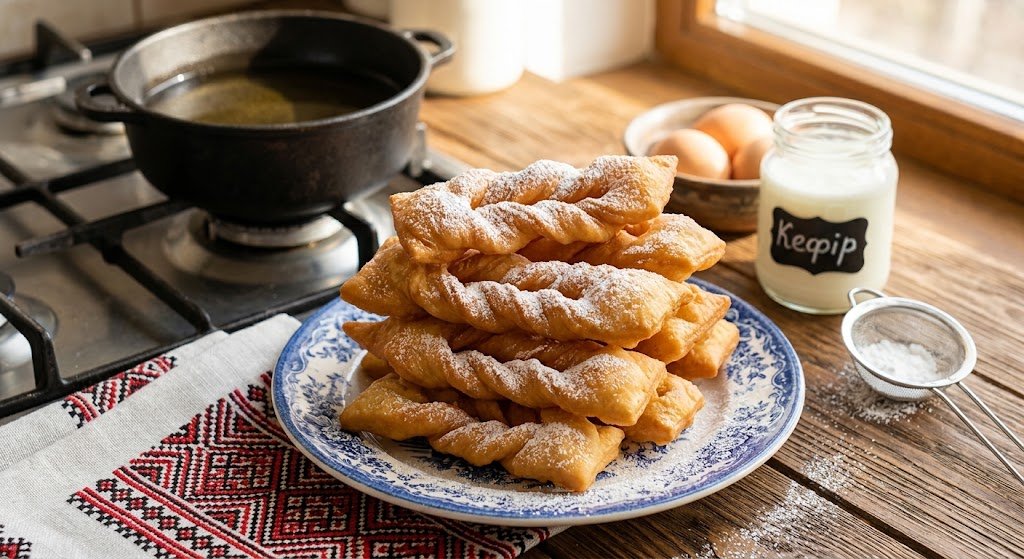
Recipe card
Ukrainian Kefir Verguny Fried Pastry Twists
60 minutes includes the 15-minute rest; frying in additional batches may add time.
Equipment: Mixing bowl, whisk, rolling pin, knife, deep heavy pot, frying thermometer, slotted spoon, rack
Ingredients
Dough
Frying
Finish
Instructions
Mix a soft kefir dough
Whisk eggs, sugar, salt and kefir. Stir in baking soda, then gradually add flour until a soft, manageable dough forms.
Rest and roll evenly
Cover and rest 15 minutes. Roll on a lightly floured surface to about 5 mm thick.
Cut and twist the strips
Cut strips 10–12 cm long, aiming for about 20 pieces. Make a slit through the centre of each, leaving ends attached, and pull one end through.
Fry in small batches
Heat neutral oil in a heavy pot no more than half full to 175°C (350°F). Fry a few twists at a time, turning when golden. Check a test pastry is fully cooked in the centre and allow oil to recover between batches.
Drain and dust
Drain on a rack or paper towels. Cool slightly and dust with icing sugar.
How to fry verguny evenly
Heat the oil to 175°C (350°F) and check with a thermometer. Lower a few pieces into the oil away from your body. They should bubble steadily and puff. Turn when the underside becomes golden and cook the other side. Open one of the first pastries after draining: its centre should be fully set, without sticky raw dough. Keep batches small and allow oil temperature to recover between them. Drain on a rack so steam can escape; dust with icing sugar while slightly warm.
Common problems
If the twists are oily, the oil may have cooled too much after adding a large batch. If the outside darkens while the centre is raw, reduce heat and check thickness. If the dough tears at the slit, leave a wider border or rest it briefly before shaping. If pastries are tough, avoid adding too much flour or overworking the dough. Do not taste raw dough containing flour and eggs.
Variations and serving
Serve with tea, coffee or a spoonful of jam on the side. A little vanilla or finely grated lemon zest is an optional flavour variation. Plain cultured buttermilk may be tried in place of kefir, although its consistency may change the flour requirement. The recipe contains wheat, milk and egg. For contrasting fried pastries, see crisp khvorost twists, no-yeast kefir doughnuts or cinnamon sugar churros.
Frying safety and storage
Never leave hot oil unattended. Keep water away from the pot, use dry utensils and turn off heat if the oil begins smoking. If oil catches fire, turn off heat if safe and cover with a metal lid; never use water or move the pot. Let oil cool completely before handling it. Cool completely on a rack and keep covered at cool room temperature for up to one day for best texture. Refrigerate for up to three days if keeping longer, and warm briefly in an oven at 160°C (320°F). Freeze cooled, undusted pastries for up to one month for best quality; thaw before warming.
Frequently asked questions
Do verguny need yeast?
Not in this recipe. Kefir and baking soda provide the lift.
Why are the twists hard?
Excess flour or rolling too thin can make them tougher. Aim for soft dough and even thickness.
Can I use an air fryer?
This recipe is designed for deep frying; air frying needs a separately tested method.
Why are they raw inside?
The oil may be too hot or the pieces too thick. Reduce heat and check the centre of a test pastry.
Can I dust with sugar ahead?
For best appearance, dust shortly before serving because sugar absorbs moisture.
More recipes to try






Spotted a detail that needs correcting? Contact the FeastDelights editors.