Open-Top Belyashi Recipe with Beef and Pork Filling
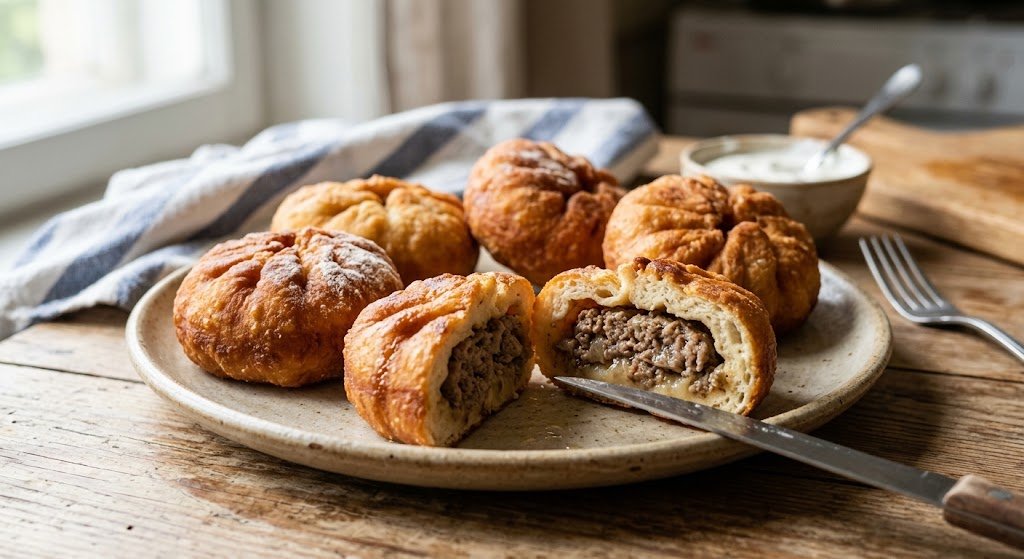
Open-top belyashi are golden fried yeast pies with a juicy beef, pork and onion filling visible through a small opening. The dough is soft inside with a lightly crisp exterior, and the cooked onions give the meat a mellow sweetness. Shape twelve pies with an even, relatively thin layer of filling and fry opening-side down first. A thermometer is important here: the meat must cook through before the dough becomes too dark. Serve warm with sour cream or a fresh cucumber salad.
These open-top belyashi are fried meat pies with a soft yeast dough, a browned crust and seasoned beef, pork and onion filling. The pleated edge leaves a small opening, distinguishing them from enclosed meat pies. The original quantities make 12 pies. Allow about 135 minutes, including yeast activation, rising, batch frying and a short rest; a small pan or slow-rising dough can extend that time.
What makes this version different?
Belyashi are savoury fried meat pies found in Eastern European and neighbouring culinary traditions, with both open and enclosed forms. This recipe uses the open-centred method and a mixed beef-and-pork filling with cooked onions. It does not claim to be the only traditional formula. The small opening makes it possible to check the filling directly and helps distinguish this version from the site’s closed yeast-dough belyashi. A separate no-yeast kefir-dough belyashi uses a different dough, and the beef belyashi with yeast dough is an alternative for cooks who prefer a beef filling.
Ingredients and equipment
Use 500 g all-purpose flour and 250 ml warm water (about one US cup plus two teaspoons). Weigh the flour: this is a fairly firm dough at the original water-to-flour ratio, and a packed measuring cup may make it unnecessarily stiff. Dry yeast needs to be fresh. Use lukewarm water around 30–35°C (86–95°F), not hot water. The teaspoon of sugar helps flavour the dough and the two tablespoons of oil make it more supple. Salt for the dough and filling is measured separately.
Use 500 g (about 1.1 lb) of mixed ground beef and pork, kept refrigerated until needed. The two finely diced onions are cooked first to soften their texture and mellow their sharpness. Let them cool before mixing with the meat, and avoid adding any excess pan liquid. Ground meat with some fat makes a juicier filling than very lean mince, but too much fat can leak through the opening. Do not taste the raw mixture to adjust seasoning.
Choose a neutral refined oil suitable for frying, such as sunflower or canola. The 700 ml (about three US cups) is the amount supplied for the frying vessel, not the amount consumed; actual absorption varies. Use a heavy, deep-sided 24–26 cm pan or pot with sufficient headroom above the oil, a thermometer for the oil, a separate clean food thermometer for the meat, long tongs or a slotted spatula, a mixing bowl and a wire rack over a tray. Never fill a frying vessel more than halfway with oil.
Recipe card
Open-Top Belyashi Recipe with Beef and Pork Filling
30 minutes active preparation + approximately 30 minutes batch frying + 75 minutes waiting (10 yeast activation, 60 rising, 5 resting) = about 135 minutes. Cook onions during the rise; allow more time for smaller batches.
Equipment: Mixing bowl; scale; heavy deep-sided 24–26 cm pan or pot; oil thermometer; food thermometer; long tongs or slotted spatula; rack and tray.
Ingredients
Dough
Meat filling
For frying
Instructions
Mix and rise the dough
Stir dry yeast and sugar into lukewarm water; stand 10 minutes or follow the yeast package. Add flour, dough salt and 2 tbsp oil. Knead about 8 minutes until elastic, cover and rise about 60 minutes until roughly doubled.
Prepare and chill the filling
While dough rises, soften diced onions over medium-low heat in a dry or lightly oiled skillet. Cool promptly, then mix with chilled ground beef and pork, filling salt and pepper. Keep covered and refrigerated.
Shape twelve open pies
Divide dough and filling into 12 equal portions. Flatten each dough portion to roughly 12–13 cm, place a thin even layer of filling in the centre and pleat edges securely, leaving a 2–3 cm opening. Keep raw pies chilled until frying.
Fry and check each filling
Heat oil to 170°C (340°F) in a deep-sided vessel no more than half full. Fry in uncrowded batches, opening-side down first, about 4–5 minutes each side. Check each filling reaches 71°C (160°F). If browning early, finish in a 160°C (320°F) oven until safe.
Drain and rest
Lift onto a clean rack or paper towels. Rest 5 minutes before serving warm. Refrigerate leftovers promptly.
Developing the dough and preparing the filling
Stir the yeast and sugar into the measured warm water and wait approximately ten minutes. If using instant yeast, follow the package instructions; some types can be mixed directly with flour. Stir the flour, dough salt and two tablespoons of oil together with the yeast mixture. Knead until smooth and elastic, about eight minutes. If the dough feels stiff, let it rest briefly before deciding whether to add water a teaspoon at a time. Keep any change small so the dough still holds its shape.
Cover and leave in a comfortably warm place until puffy and roughly doubled, approximately one hour. Do not place the bowl on a hot appliance. A cool kitchen may need extra time. While it rises, soften the chopped onions over medium-low heat in a dry or very lightly oiled skillet, stirring until translucent. Avoid browning them deeply or leaving them wet. Spread them in a shallow dish to cool promptly; refrigerate if you are not ready to use them.
Mix the cooled onions, chilled ground beef and pork, filling salt and black pepper just until evenly distributed. Overworking the mixture can make the cooked filling compact. Keep covered in the refrigerator while dividing the dough. Clean the board, hands and utensils after touching raw meat, and use a clean plate for fried pies.
Shaping open-centred pies
Divide the dough into twelve equal portions, about 65 g each before any adjustment. Divide the filling into twelve portions as well; its final weight varies with onion size and cooking loss. Keep the raw portions cold and covered, bringing out only what you are about to shape. Flatten each dough ball into a circle roughly 12–13 cm across, slightly thicker in the centre than at the rim. The disc needs enough width to pleat without tearing.
Place one portion of filling in the middle and flatten it to an even, relatively thin layer. Lift the outer edge of the dough in small pleats towards the centre, pinching adjacent folds together. Leave a small opening of roughly 2–3 cm, so the filling remains visible and the surrounding seam is secure. Gently flatten the shaped pie without forcing meat through the opening. A thick mound of raw filling is harder to cook through before the bread browns.
Keep any unshaped dough covered. If a round shrinks when flattened, rest it for a few minutes. Work in batches rather than leaving all the filled raw pies waiting near a warm stove. Avoid loose flour on the surface; it can burn in the oil. Pinch any accidental tear closed before frying.
Frying and checking the meat
Heat the oil gradually to around 170°C (340°F). The oil should be deep enough for the pies to fry evenly without the pan being overfilled. Keep the handle secure, the area dry and children away from the hot vessel. Lower each pie gently into the oil with the opening facing down, using a long spatula and moving away from yourself. Do not drop it from a height. Fry only as many as fit comfortably without touching; three or four may fit depending on their diameter.
Cook about four to five minutes on the first side, then turn carefully and cook another four to five minutes. The temperature may drop when pies enter the pan. Let it recover between batches and lower the heat if the crust darkens rapidly. The dough should become golden and set through, but appearance is not enough to confirm the meat is safe.
Use a clean thin-tip food thermometer through the opening to measure the thickest part of the filling, avoiding contact with the pan or hot oil. Check every pie: mixed ground beef and pork must reach at least 71°C (160°F). If a pie is already deeply browned but the centre is below this temperature, remove it to a baking tray and finish in a moderate 160°C (320°F) oven until the filling reaches the required temperature. Do not serve an undercooked pie. Clean the thermometer probe between checks of raw or undercooked filling.
Allow roughly 25–35 minutes for frying in batches; a smaller vessel may require longer. Drain the cooked pies on a rack or paper towels and rest five minutes before eating. Hot filling and trapped steam can burn the mouth. Turn the heat off when finished and allow the oil to cool in place; never move a vessel of hot oil or add water to it.
Troubleshooting
The dough tears during shaping: cover and rest the portions briefly to relax the gluten. Check whether too much filling is being squeezed into one pie. Patch any hole outside the intended opening before frying.
The pleats open up: keep the dough edge free of oil and filling, then pinch firmly. Too much bench flour interferes with sealing. Do not close the intentional central opening.
The crust browns before the meat is done: make the filling thinner, control the oil temperature and check the centre. Finish the current pie in the oven if necessary. Do not assume a browned exterior means the ground meat is cooked.
The pies are oily: overcrowding cools the oil and slows crust formation. Fry fewer at a time, allow the oil to recover, and drain on a rack. Do not compensate by heating the oil until it smokes.
The filling is dry: very lean meat or prolonged cooking can reduce juiciness. Use the original onion quantity, do not overmix, and stop cooking once the crust is set and the safe centre temperature is reached.
Substitutions and serving
All-beef mince can replace the mixed meat by weight, although the flavour and fat content will change. It still needs to reach 71°C (160°F). Add a little finely chopped parsley for freshness or a pinch of additional pepper if desired. Keep herbs finely chopped so they do not interfere with shaping. Smaller appetizer pies can be made from the same dough, but their cooking time and yield will change; check each centre. Do not use a baking-only method as a direct substitute without developing it separately.
Serve warm with sour cream, sliced cucumber or tomato salad. A light broth or unsweetened tea also works alongside the rich fried dough. Keep wet toppings beside the pies rather than spooning them over the crust in advance.
Make ahead, storage and allergens
Prepare the dough separately in advance if needed, cover and refrigerate overnight, then allow it to become pliable and complete its rise before shaping. Keep raw meat at 4°C (40°F) or below and use it within the package date and one to two days of refrigeration. Cook onions ahead, cool promptly and refrigerate separately. Assemble shortly before frying. Do not leave raw filled pies at room temperature for extended periods.
Refrigerate cooked pies within 2 hours (1 hour above 32°C/90°F), at 4°C (40°F) or below; use within 2 days. Reheat to 74°C (165°F). Freeze cooked, cooled pies airtight for up to 1 month for best quality, then thaw in the refrigerator before reheating. For crispness, reheat on a rack in a 180°C (350°F) oven, checking the filling temperature. A microwave can soften the crust. Do not reheat by dropping frozen pies into hot oil. Contains wheat; optional sour cream adds milk. Check oil and equipment for allergen cross-contact. Nutrition is not calculated because frying oil absorption is unknown.
Keep the pies evenly shaped, watch the oil temperature and check the meat in each pie before serving. Enjoy the contrast of the golden crust and juicy filling while the belyashi are still warm.
Frequently asked questions
Why leave a hole in the middle?
It is the defining shape of this open-top version and provides access to the filling for a temperature check.
Which side should I fry first?
Lower the pie carefully into the oil opening-side down, then turn it after the first side sets and browns.
Can I use only beef?
Yes. Replace the mixed mince by weight and check that the centre reaches 71°C (160°F).
How do I know the meat is cooked?
Check the thickest part of each filling with a food thermometer. It must reach at least 71°C (160°F).
What if the dough browns too quickly?
Reduce the oil heat. If necessary, finish the already browned pie in a moderate oven until the meat reaches its safe temperature.
Can I reuse the frying oil?
Let it cool fully, discard it if it smells rancid, smokes unusually or has dark burnt particles, and follow local disposal guidance. Never pour oil down a drain.
Can I freeze them?
Freeze fully cooked, cooled pies airtight, thaw in the refrigerator and reheat to 74°C (165°F).
Can I shape all the pies in advance?
Keep raw filled pies covered and refrigerated and cook them promptly. For best texture, shape in small batches close to frying.
More recipes to try






Spotted a detail that needs correcting? Contact the FeastDelights editors.