Colomba Recipe: Yeast-Raised Italian Easter Dove Bread
An enriched Easter dove bread with candied orange peel and an almond-sugar topping, made with instant yeast for a home-kitchen schedule.
This colomba recipe makes a fragrant Italian Easter bread with candied orange peel and an almond-sugar top. The dove shape is traditional, while this home version uses instant yeast rather than a multi-stage lievito madre process. It is an enriched bread with butter, eggs and sugar, so give the dough time to become elastic and rise fully. Plan about six and a half hours, including two rises and cooling, with extra time if your kitchen is cool. A one-kilogram paper colomba mold supports the characteristic crossed pieces of dough. The finished loaf should be golden, softly structured and scented with orange, with a lightly crisp almond crust that contrasts with the tender crumb.
Build strength before adding the butter
Use bread flour and a stand mixer if possible. The dough initially looks sticky, then becomes smoother as gluten develops. Add soft butter in small portions only after that initial development; putting it all in at the beginning can slow the process.
This is a simplified yeast-raised interpretation rather than an exact replacement for artisan sourdough colomba. Rise times are estimates. Look for a clearly expanded, light dough and keep the room gently warm rather than placing the bowl against a hot radiator or in a hot oven.
Recipe at a glance
Yield: 1 loaf, about 1 kg; 12 slices. Active preparation: about 45 minutes. Cooking: about 40 minutes. Total elapsed time: about 385 minutes. Includes about 300 minutes of resting, rising, cooling or chilling, as specified in the method.
How to make colomba: yeast-raised italian easter dove bread
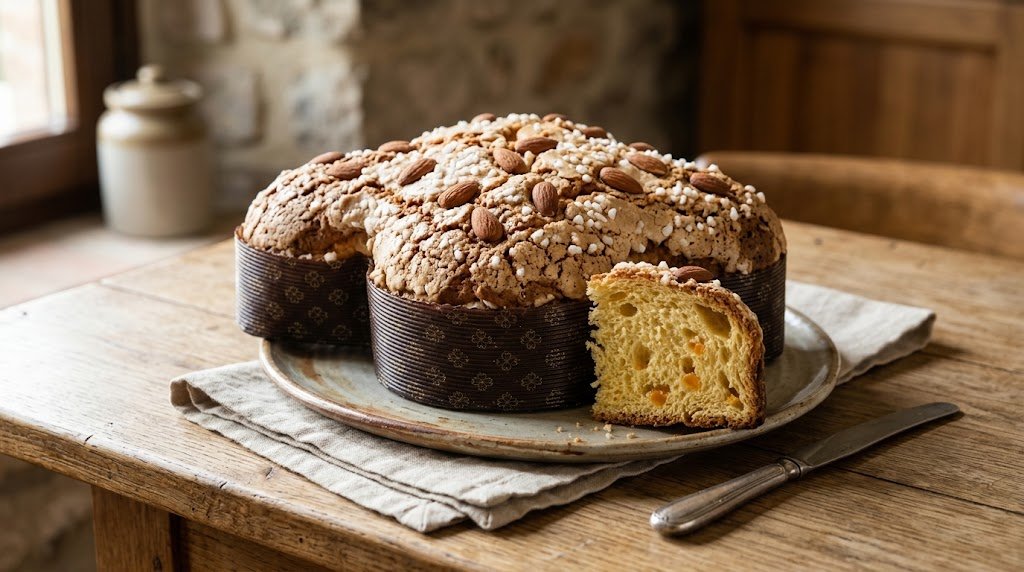
Recipe card
Colomba Recipe: Yeast-Raised Italian Easter Dove Bread
Equipment: Stand mixer with dough hook; kitchen scale; 1 kg paper colomba mold; baking sheet; bowl; pastry brush; instant-read thermometer; rack.
Ingredients
Dough
Topping
Instructions
Mix the initial dough
Combine flour, yeast, sugar and salt in the mixer bowl. Add lukewarm milk, eggs, yolk, zest and vanilla. Mix on low until combined, then knead at the mixer’s recommended dough speed for 8–10 minutes until increasingly elastic.
Work in butter and fruit
Add softened butter a few cubes at a time, letting each addition incorporate. Knead another 8–12 minutes until smooth and stretchy. If the dough or mixer becomes hot, stop briefly. Mix in candied peel on low.
First rise
Cover and leave around 24–26°C/75–79°F for about 2 hours, or until roughly doubled. This rich dough may take longer in a cool room; do not shape it while still dense.
Shape the dove
Set the paper mold on a baking sheet. Divide dough into two pieces, one slightly larger. Form the smaller piece into the wing section across the mold, then lay the longer body piece over it lengthwise. Distribute dough into the mold contours without tightly packing it.
Second rise and topping
Cover loosely and let rise about 2 hours until very puffy and approaching the upper part of the mold. Heat oven to 175°C/350°F conventional. Mix egg white, almond flour and 40 g topping sugar into a spreadable paste. Brush gently over the dough and scatter almonds and pearl sugar.
Bake and cool
Bake 35–45 minutes until deep golden and the center reaches about 90°C/194°F. Tent loosely with foil if the topping darkens early. Cool in the mold on a rack for at least 1 hour before slicing.
How to tell when it is ready
The loaf is deeply golden, the center reaches about 90°C/194°F and a cooled slice has an airy, set crumb without a wet band.
Tips
- Use a mold rated for baking, with its stated capacity.
- Add butter gradually after the dough begins developing strength.
- Judge rises by expansion rather than the clock alone.
- Tent the almond topping if it darkens before the center cooks.
Troubleshooting
- Slow rise: the room may be cool; allow more time if the dough is showing steady activity.
- Butter leaks: it was added too fast or the dough overheated; cool briefly and continue kneading.
- Dense crumb: allow fuller rises and check that the center is baked before cooling.
Substitutions
- Use chopped dried apricots instead of candied peel for a different fruit bread.
- If pearl sugar is unavailable, omit it; ordinary fine sugar does not provide the same crunchy pieces.
Variations
- Orange-and-raisin version: replace 60 g peel with 60 g raisins, patted dry if soaked.
- Without a dove mold, use two suitable loaf pans and divide the dough evenly; begin checking sooner because loaf geometry changes baking time.
Serving suggestions
- Slice when cooled and serve with coffee.
- Offer alongside fruit for an Easter breakfast.
- Toast day-old slices in a toaster oven.
- Serve plain or with a thin spread of butter.
Make ahead
Measure ingredients and prepare the mold a day ahead. Bake the day before serving if needed, cool fully and wrap. Rise times may lengthen; do not cut them short to fit a fixed appointment.
Storage
Once fully cool, wrap tightly and keep at cool room temperature for up to 2 days for quality. Freeze sliced portions for up to 2 months; thaw wrapped. Toast in a toaster oven rather than an upright toaster where loose sugar can burn.
Food safety
Do not taste raw egg-and-flour dough or topping. Use clean utensils for the reserved white, which goes into the baked topping. Contains wheat, eggs, milk and almonds.
Frequently asked questions
Is this a lievito madre colomba?
No. It is explicitly an instant-yeast home version. Traditional long-fermented methods need different starter management and schedules.
Can I slice it straight from the oven?
Wait at least an hour. The crumb continues setting during cooling and tears or compresses more easily while hot.
More recipes to try


Spotted a detail that needs correcting? Contact the FeastDelights editors.