Refrigerator Pickled Cabbage Petals with Beet
Large white cabbage petals turn a vivid pink when marinated with thin beet slices, garlic, bay leaves and peppercorns. This Eastern European-style refrigerator side dish has a mild sweet-sour flavour and a crisp bite. The original diluted vinegar mixture is retained as a seasoning marinade, not as a preservation brine. Prepare the vegetables and hot marinade in about 35 minutes, then refrigerate for 24 hours before serving. Keep the dish cold and enjoy it within three days of preparation.
Refrigerator pickled cabbage petals with beet are chunky pieces of cabbage marinated in a mild garlic and vinegar mixture until rosy and crisp. Serve them cold as an Eastern European-style vegetable side. Allow about 35 minutes of preparation and heating, then 24 hours of refrigeration.
Important: a fresh refrigerated marinade, not a preserve
The original recipe uses 100 mL of 9% vinegar in one litre of water. That is a relatively dilute mixture, and its final acidity in the vegetables has not been tested. It is retained for flavour only. This dish must be treated as a fresh refrigerated salad and eaten within three days of preparation, including marinating time. Do not ferment on the counter, can, vacuum-seal for pantry storage or infer safety from a sour taste. The University of Minnesota Extension pickling guidance distinguishes refrigerator pickles from shelf-stable products. For long-term preservation use a separate tested recipe with its exact vinegar strength and processing method.
Choose cabbage, beet and vinegar
Choose a firm white cabbage and remove its tough core. Cut the leaves into broad petals rather than finely shredding them; the large pieces are this version’s defining feature. Thin beet slices release colour readily. Garlic, bay leaves and black peppercorns perfume the marinade. Use only commercial food-grade vinegar with the stated 9% acidity, not cleaning vinegar or homemade vinegar of uncertain strength. Measure salt and sugar rather than estimating by eye.
How to prepare the cabbage petals
Use clean heat-safe containers and utensils. Divide the batch into smaller containers if necessary to cool it promptly. Prepare the vegetables before heating the marinade so it can be poured over them without a long delay.
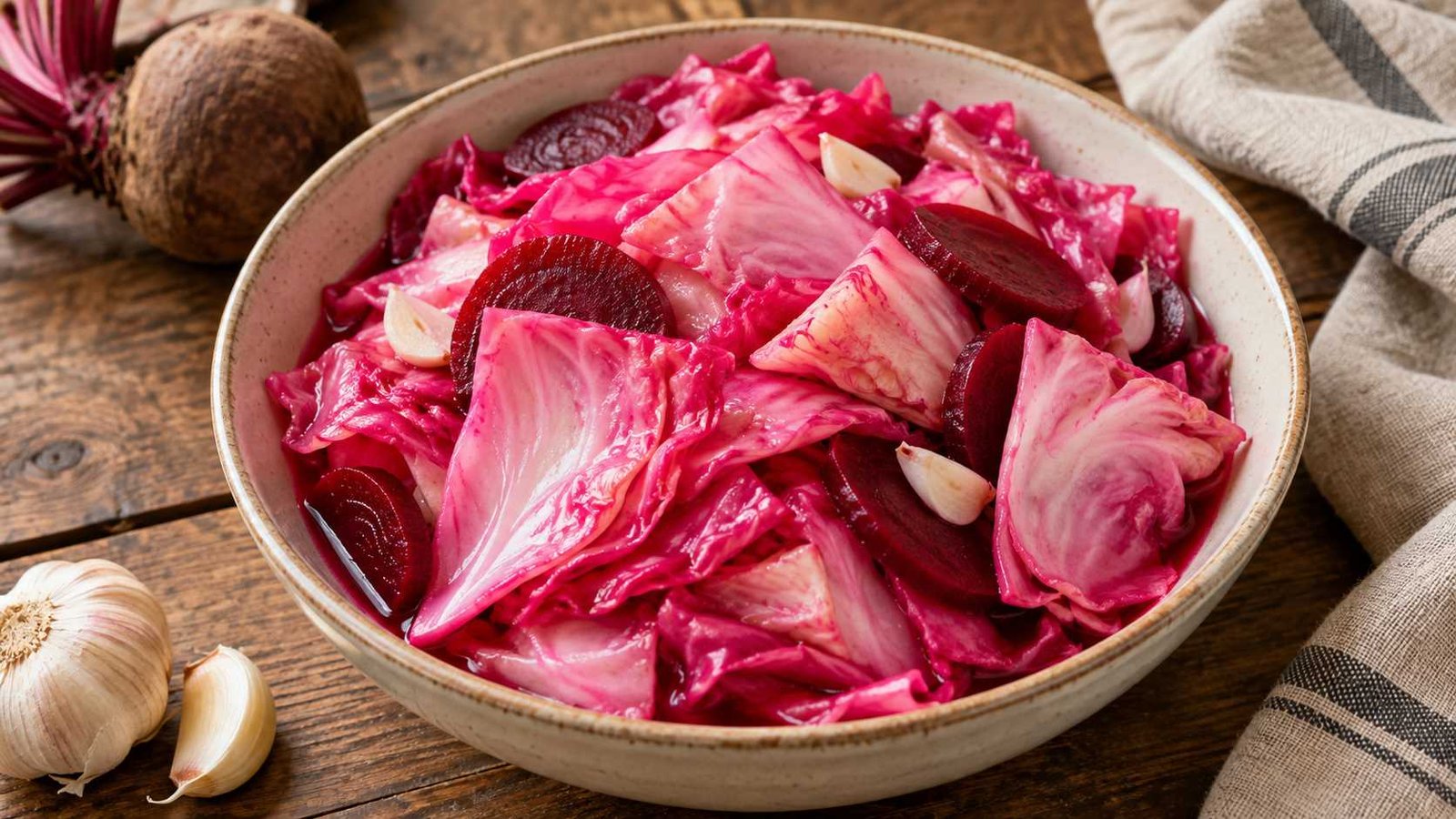
Recipe card
Refrigerator Pickled Cabbage Petals with Beet
25 minutes active prep, 10 minutes heating and 24 hours refrigerated marinating included in prep field; cool promptly before chilling.
Equipment: Knife, chopping board, saucepan, measuring jug, clean heat-safe containers and refrigerator thermometer
Ingredients
Vegetables
Marinade
Instructions
Cut cabbage and beet
Wash produce under running water. Remove damaged cabbage leaves and core, cut into roughly 4–5 cm petals, peel and thinly slice beet and crush garlic.
15 minPrepare the hot marinade
Bring water, sugar, salt, bay and peppercorns to a boil, simmer for 5 minutes, remove from heat and stir in the measured food-grade 9% vinegar.
10 minPack clean heat-safe containers
Divide cabbage, beet and garlic between clean, heat-safe containers sized to hold the vegetables without crushing them. Use smaller containers to aid cooling.
10 minCover vegetables and chill promptly
Pour the hot marinade over the vegetables to cover them. Cool quickly using a cold-water bath around the containers if necessary, then cover and refrigerate promptly, within two hours at most. Do not leave on the counter overnight.
Marinate in the refrigerator
Refrigerate at 4°C (40°F) or below for 24 hours. Use a clean fork to serve cold. Use the entire batch within three days of preparation; this marinade is not validated for preservation.
1440 min
Texture, colour and troubleshooting
Thin beet slices colour the surrounding cabbage gradually. The outer layers may turn pink faster than thicker sections, which is normal. Keep the vegetables covered by marinade and rearrange them using a clean utensil if needed. If the liquid is insufficient, divide the vegetables into smaller containers rather than adding water. The cabbage should retain a crisp bite; it need not become soft like cooked cabbage. Do not use colour, texture or smell as a test of safety.
Serving ideas and variations
Drain a portion with a clean fork and serve alongside roasted meat, cooked potatoes or dark bread. A little chopped fresh dill can be added at serving time. For another vegetable side, compare our cabbage and beet refrigerator salad, Georgian-style cabbage with beet or cabbage with carrot and beet. These are distinct preparations; do not interchange their storage or brine instructions.
Storage and allergens
Treat this as a fresh marinated vegetable salad, not a preserved food. Refrigerate promptly at 4°C (40°F) or colder and use within 3 days of preparation, including the 24-hour marinating time. Use clean utensils, return to the fridge within 2 hours (1 hour above 32°C/90°F), and never store at room temperature. Do not freeze or reuse the marinade for preservation. Label the containers with the preparation date. No major allergens are intentionally included in the listed ingredients; check the vinegar label and any accompaniments. If the refrigerator temperature or storage history is uncertain, discard the batch.
Frequently asked questions
Is this a fermented cabbage recipe?
No. The flavour comes from added vinegar, not a controlled fermentation.
Can I keep the jar in the pantry?
No. This is a short-term refrigerated vegetable salad, not a tested canning recipe.
Can I substitute 5% vinegar?
Do not substitute weaker vinegar in equal volume. The original recipe specifies 9% food-grade vinegar. For preservation use a separate laboratory-tested recipe.
Why is the cabbage pink?
Natural pigments from the beet diffuse into the marinade and cabbage during chilling.
What if the vegetables are not covered?
Divide into smaller containers or rearrange the pieces. Do not dilute the marinade further.
Can I reuse the marinade?
No. Discard used marinade; it is not a reliable preservation liquid.
Does the colour indicate that it is safe?
No. Colour and sourness cannot establish microbial safety. Follow the refrigeration and short storage limits.
More recipes to try




Spotted a detail that needs correcting? Contact the FeastDelights editors.